Why Medical Dermatology Matters for Primary Care Providers
Skin disorders affect up to one‑in‑three patients and can signal systemic disease, impair quality of life, and increase morbidity. Conditions such as eczema, psoriasis, rosacea, acne, and early skin‑cancer lesions often first appear in primary‑care settings, making clinicians essential for identification and referral. Rapid, evidence‑based tools—like the concise tables, algorithms, and differential‑diagnosis sections in Dermatology Essentials—enable physicians to recognize patterns, initiate appropriate interim therapy, and order targeted tests without delay. By integrating these resources into everyday practice, primary‑care providers improve patient outcomes, reduce unnecessary specialist visits, and support personalized, cost‑effective care. The combination of visual aids, algorithmic guidance, and treatment recommendations empowers clinicians to manage common dermatologic problems confidently and efficiently. Additionally, clinicians can educate patients on sun protection, trigger avoidance, and lifestyle modifications, reinforcing preventive strategies that complement medical therapy.
Fundamentals of Medical Dermatology in Primary Care
 Dermatology Essentials, 2nd Edition (Elsevier, 2022) is a concise, evidence‑based handbook designed for primary‑care clinicians, providing over 1,800 clinical images and quick‑reference tables that streamline bedside diagnosis. The text emphasizes a systematic approach to basic dermatology principles—inspection of lesion morphology, distribution, and pattern—paired with bedside tools such as dermoscopy and Wood’s lamp to differentiate benign from malignant findings. For patients presenting with fever and rash, the book offers a step‑wise algorithm that narrows the differential by integrating age, exposure history, and characteristic features (e.g., target lesions for erythema multiforme or morbilliform eruptions for drug reactions). Urticaria and acute drug‑induced rashes are addressed with clear flowcharts that guide clinicians through antihistamine selection, identification of potential allergens, and when to pursue patch testing. Throughout, concise tables list common ‑x/Rx options for acne, atopic dermatitis, psoriasis, rosacea, and actinic keratosis, enabling rapid, personalized treatment decisions for patients at On The Spot Dermatology in Glenview, IL.
Core Skin Conditions: Presentation, Diagnosis, and First‑Line Management
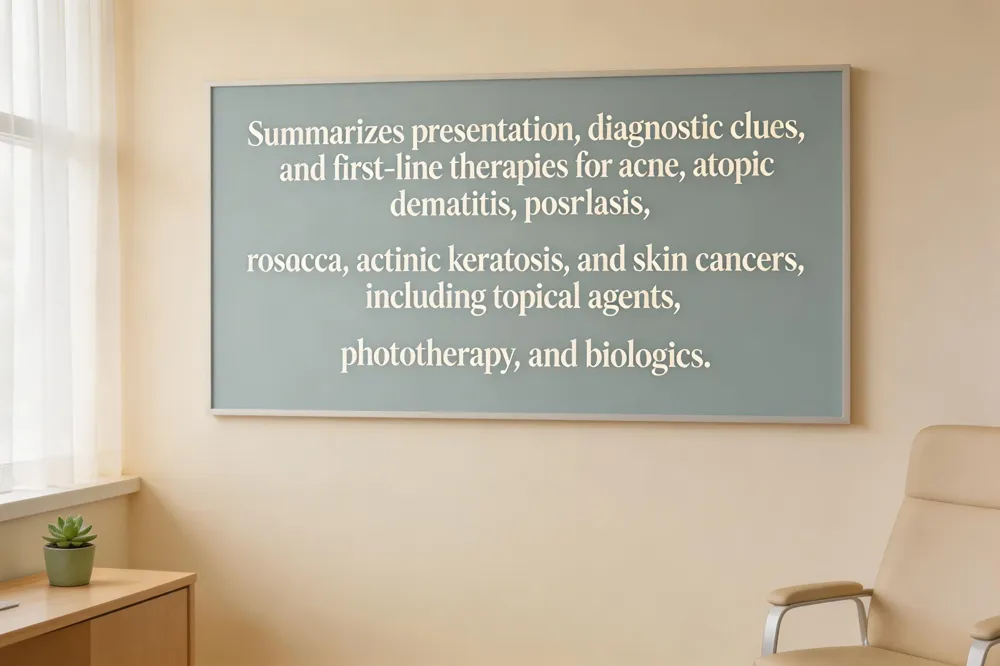 Acne vulgaris arises from follicular hyperkeratinization, excess sebum, *Propionibacterium acnes proliferation. First‑line therapy includes topical retinoids (e.g., tretinoin) to normalize keratinocyte differentiation, benzoyl peroxide for its antibacterial and anti‑inflammatory effects, and topical or oral antibiotics for moderate disease.
Atopic dermatitis (eczema) is a chronic inflammatory disorder marked by intense itch, xerosis, and barrier disruption. Management starts with barrier repair using fragrance‑free moisturizers, followed by low‑to‑moderate potency topical corticosteroids for flare‑ups. In moderate‑to‑severe cases, the IL‑4/13 antagonist dupilumab offers a biologic option with proven efficacy.
Psoriasis presents as well‑demarcated, erythematous plaques with silvery scale. First‑line treatments include topical vitamin D analogues (calcitriol, calcipotriol) and phototherapy (narrow‑band UVB). For moderate‑to‑severe disease, biologic agents targeting TNF‑α, IL‑12/23, or IL‑17 pathways provide systemic control.
Rosacea is characterized by facial flushing, persistent erythema, papulopustules, and telangiectasia, often triggered by heat, alcohol, or spicy foods. Topical metronidazole or azelaic acid reduces inflammation, while oral doxycycline (sub‑antimicrobial doses) addresses papular lesions. Laser or intense pulsed light can treat vascular components.
Actinic keratosis is a UV‑induced precancerous lesion that may progress to squamous cell carcinoma. Cryotherapy offers rapid removal; topical 5‑fluorouracil or imiquimod provides field‑directed therapy, and photodynamic therapy (PDT) is effective for multiple lesions.
Skin cancers include basal cell carcinoma (BCC), squamous cell carcinoma (SCC), and melanoma. Early detection relies on the ABCDE rule for melanoma and meticulous visual inspection for BCC/SCC. Definitive diagnosis requires biopsy, and Mohs micrographic surgery is the preferred technique for high‑risk or cosmetically sensitive lesions, ensuring maximal tissue preservation and cure rates.
Evidence‑Based Resources for Clinicians
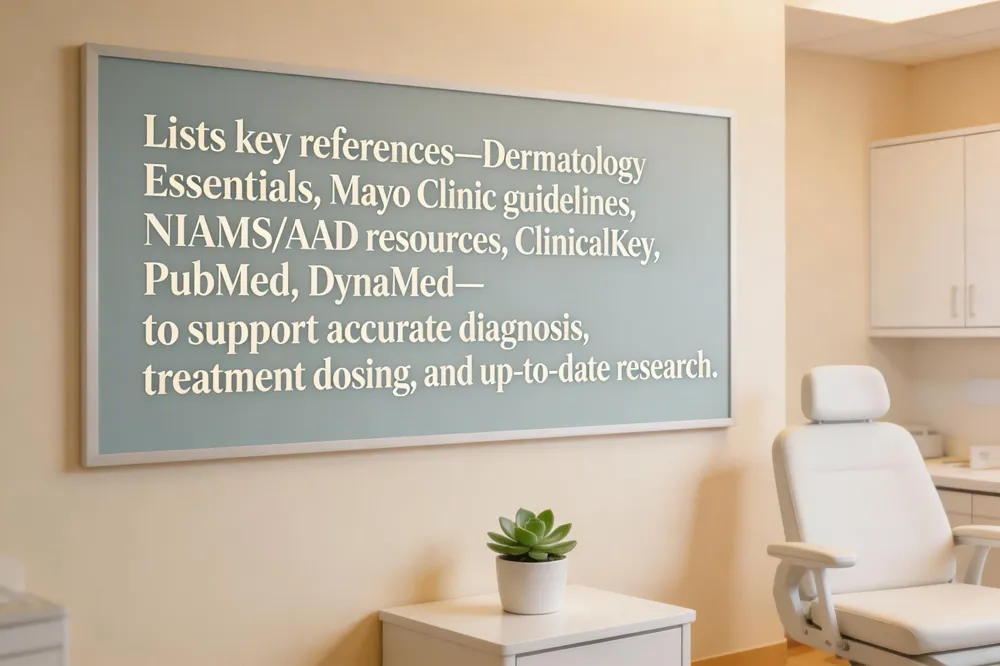 Clinicians in Glenview and beyond rely on several trusted, evidence‑based references to guide both medical and cosmetic dermatology care.
Dermatology Essentials (2nd edition) – edited by Bolognia, Schaffer, Duncan, and Ko, this 1,104‑page text offers concise tables, algorithms and more than 1,800 clinical images that enable rapid differential diagnoses (DDx) and treatment decisions (Rx) for primary‑care providers, including family medicine, internal medicine, nurse practitioners, and physician assistants.
Mayo Clinic guidelines – emphasize the role of pathology slide analysis for accurate diagnosis and provide clear, evidence‑based treatment recommendations for acne, eczema, psoriasis, rosacea, skin cancers and precancerous lesions such as actinic keratosis.
NIAMS and American Academy of Dermatology (AAD) – supply comprehensive symptom pattern descriptions, diagnostic test algorithms (patch testing, dermoscopy, Wood’s lamp) and lifestyle modification advice (sun protection, moisturization, trigger avoidance) that empower patients to manage chronic conditions like atopic dermatitis and rosacea.
ClinicalKey, PubMed, and DynaMed – deliver point‑of‑care drug dosing, safety data, and up‑to‑date research findings, allowing clinicians to quickly verify medication choices such as topical retinoids, biologic agents, or phototherapy protocols.
Together, these resources support personalized, evidence‑driven dermatologic care.
Glenview Dermatology Practices – Services and Patient Experiences
 Glenview residents have several full‑service dermatology options that blend medical expertise with cosmetic care. On The Spot Dermatology, located in Glenview, IL, offers board‑certified physicians who treat acne, eczema, psoriasis, rosacea and skin cancer, and also provide advanced aesthetic procedures such as Botox®, dermal fillers, chemical peels, laser resurfacing and IPL photofacials. The Skin Care Center’s Glenview office (2551 Compass Rd., Suite 105) adds Mohs micrographic surgery, patch testing, photodynamic therapy and a full suite of injectables, all delivered by dermatologists like Dr. Mark Allan Berk and Dr. Gina Marie Dillig. Northwestern Medicine’s Glenview Outpatient Center (2701 Patriot Blvd.) extends services to exosome therapy for hair regrowth, comprehensive skin‑cancer screening, and surgical dermatology, with board‑certified clinicians including Dr. Benjamin R Marks. Patient feedback is uniformly positive: The Skin Care Center holds a 4.7‑star rating on Google, while Northwestern Dermatology Glenview enjoys a 4.8‑star average from more than 2,200 reviews, praising knowledgeable staff, personalized treatment plans and a compassionate, patient‑first approach. Together, these practices provide Glenview’s community with accessible, evidence‑based skin health and aesthetic solutions.
Additional Glenview Offices – Lake Forest and Halsted Locations
 The Skin Care Center’s Lake Forest office, situated on the Northwestern Lake Forest Hospital campus at East Deerpath Road and Oakwood Avenue, offers a full suite of medical, surgical, and cosmetic dermatology services. Board‑certified providers treat acne, eczema, psoriasis, skin cancer, and anti‑aging concerns, and perform Mohs micrographic surgery, laser therapies, Botox®, chemical peels, and facial fillers. Patients from the North Shore, Chicago suburbs, and southern Wisconsin benefit from personalized care and a wide range of accepted insurance plans.
The Halsted location in Chicago’s Lake View East neighborhood occupies Suite 401 on the fourth floor of the Medical Office Center at North Halsted Street and West Wellington Avenue. It is a short walk from the Wellington Red‑Line “L” station, with an attached Halsted Garage for ample parking. This office mirrors the Lake Forest offerings, providing acne management, skin cancer screening, Mohs surgery, laser resurfacing, microneedling, and cosmetic injectables in a modern, patient‑focused setting.
Putting Knowledge into Practice
At On The Spot Dermatology in Glenview, IL, board‑certified physicians blend medical and cosmetic services to address the full spectrum of skin health. A patient presenting with acne, eczema, psoriasis, or rosacea receives evidence‑based medical therapy—topical retinoids, corticosteroids, phototherapy, or biologics—while simultaneously benefiting from cosmetic options such as laser resurfacing, chemical peels, or injectable neuromodulators that improve texture and appearance. The practice draws on trusted references like Dermatology Essentials (2nd ed.) and Mayo Clinic guidelines, ensuring that each treatment plan follows the latest algorithms and safety standards. Local expertise, including Mohs surgery, patch testing, and photodynamic therapy, is integrated with personalized education on sunscreen, trigger avoidance, and lifestyle modifications, resulting in faster relief, reduced scarring, and long‑term skin preservation. Follow‑up visits are scheduled to monitor progress, adjust therapies, and reinforce habits for results.