Getting Ready for Your Dermatology Consultation
Your first dermatology visit is a cornerstone of skin health. Early detection of skin cancer—one in five Americans will develop it—greatly improves outcomes, and a full‑body exam establishes a baseline for monitoring acne, eczema, rosacea, and aging changes. To make the most of the appointment, wear loose, easily removable clothing, shower and skip makeup, nail polish, and heavy hair products. Bring a notebook with a list of current medications, supplements, and skincare products, plus photos or a timeline of any new or changing lesions. Prepare questions about sunscreen, exfoliation, and treatment options, and be honest about lifestyle factors such as sun exposure. Expect a thorough history, an exam using a dermatoscope, and a care plan that may include topical therapy, procedures, or cosmetic options.
Red‑Flag Signs and Quick Wins Before You Walk In
| Red‑Flag Sign | Description | Immediate Action |
|---|---|---|
| Changing mole | Size, shape, color change, itching, bleeding, or pain | Schedule a dermatologist appointment ASAP |
| Non‑healing ulcer | Open sore that does not improve in 2‑3 weeks | Call your doctor promptly |
| Persistent blisters | In mouth, eyes, or genital area | Seek medical evaluation promptly |
| Rash with systemic symptoms | Fever, weight loss, joint pain, or fatigue accompanying rash | Urgent dermatology visit |
| Sudden painful swelling with fever | Possible cellulitis or necrotising fasciitis | Emergency care or urgent appointment |
| What NOT to do | Avoid nail polish, heavy makeup, self‑tanners, new strong skincare products, shaving/waxing unless instructed, and large jewelry | Arrive with clean, unobscured skin and a written list of concerns |
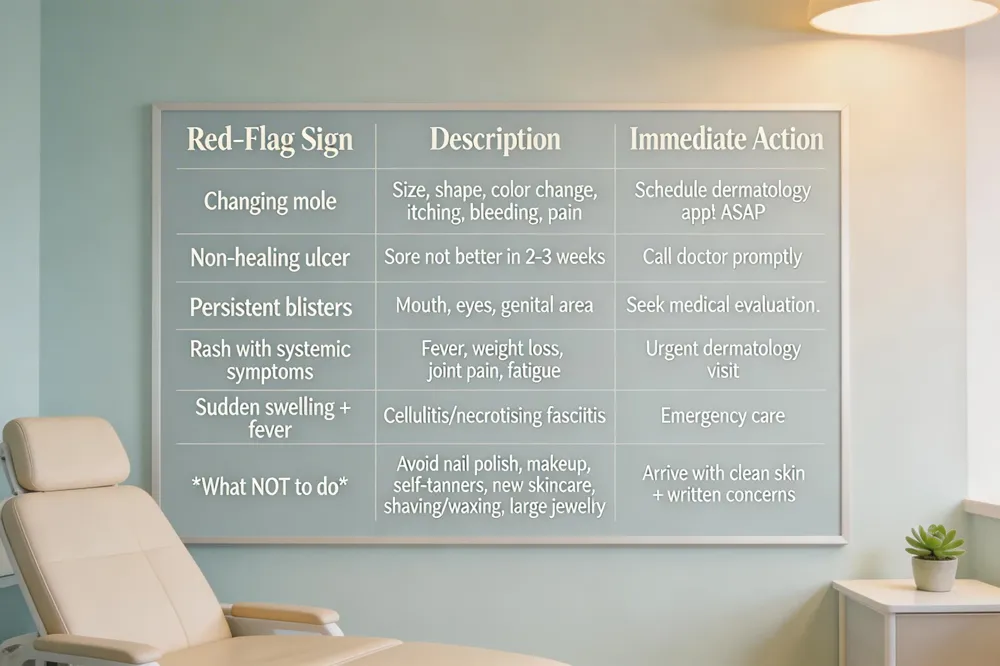 Before you step into the dermatologist’s office, it’s helpful to know what skin changes merit urgent attention and how to prepare for a thorough exam. A red flag in dermatology is any lesion or symptom that could signal a serious condition such as skin cancer, infection, or autoimmune disease. Look for moles that change in size, shape, or color, or that start itching, bleeding, or becoming painful—these are classic warning signs for melanoma. Other red‑flag symptoms include non‑healing ulcers, persistent blisters in the mouth, eyes, or genital area, rashes accompanied by fever, weight loss, or joint pain, and sudden painful swelling with fever, which may indicate cellulitis or necrotising fasciitis. If any of these appear, schedule an appointment promptly.
For patients concerned about lupus, remember the “5 L’s” mnemonic: Lupus (the underlying autoimmune disease), Leveraging (UV light can trigger flares), Lesions (papules, plaques, or discoid rash), Localization (commonly on sun‑exposed face, ears, scalp, neck), and Lateness (chronic, often delayed onset). This framework helps you describe findings accurately.
What not to do before your visit: avoid nail polish, heavy makeup, self‑tanners, or new strong skincare products that can mask lesions; skip shaving or waxing unless instructed; and leave large jewelry or accessories at home. Arriving with clean, unobscured skin and a written list of concerns will let the dermatologist focus on the most important issues and provide the best care.
Checklist: What to Bring and What to Avoid
| Bring | Details |
|---|---|
| Government‑issued photo ID | Driver’s license, passport, etc. |
| Insurance card or proof of coverage | Include group number and policy holder name |
| Referral (if required) | Printed copy from primary care provider |
| Medication & skin‑care list | Include prescriptions, OTC, supplements, topicals, dosages, frequency |
| Recent labs/biopsy reports | Any relevant dermatology or systemic test results |
| Photos of concerning lesions | Clear, well‑lit images from different angles |
| Notebook & pen | For notes and questions |
| Avoid | Details |
|---|---|
| Nail polish, heavy makeup, self‑tanners | Can mask lesions |
| New strong skincare products | May cause irritation or hide findings |
| Shaving or waxing (unless instructed) | Can irritate skin and obscure lesions |
| Large jewelry or accessories | Obstructs examination of underlying areas |
| Tight or hard‑to‑remove clothing | Makes full‑body exam difficult |
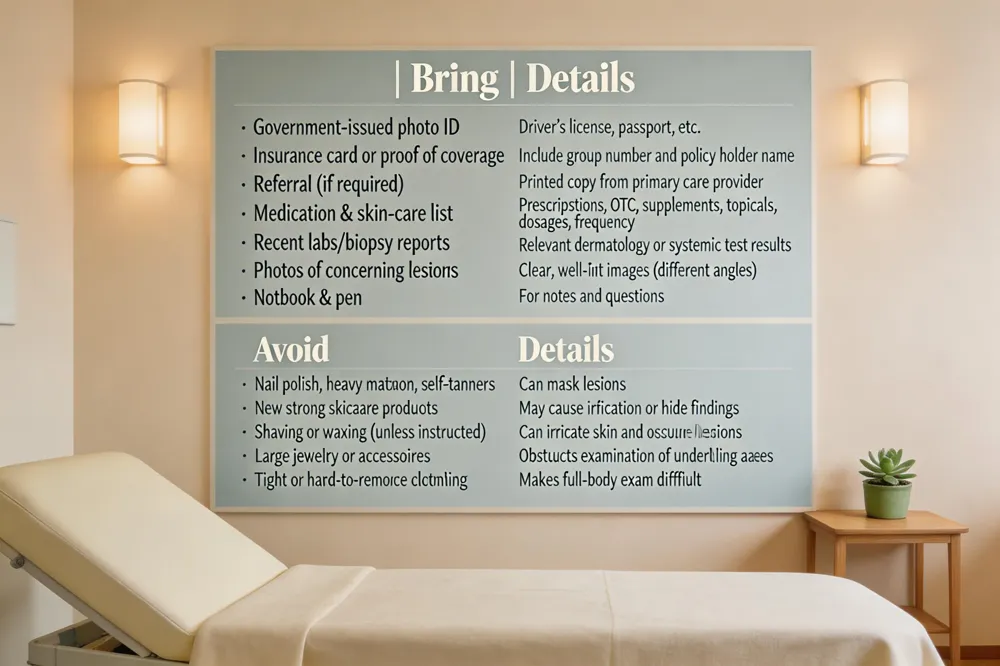 Preparing for your first dermatology visit is simple when you know exactly what to bring and what to leave at home.
Documents and IDs – Bring a government‑issued photo ID and your insurance card (or proof of coverage). If you have a referral, pack it as well.
Medication and skin‑care product lists – Write down every prescription, over‑the‑counter drug, supplement, and topical product you use, including dosages and frequency. Include recent lab or biopsy reports and a brief medical and skin‑history summary (family skin disease, past sunburns, treatments).
Clothing and grooming advice – Wear loose, easy‑to‑remove clothing; avoid makeup, nail polish, and heavy hair products. A shower beforehand ensures skin is clean and free of creams that could mask findings.
Underwear considerations – For a full‑body exam you’ll typically change into a medical gown. Many practices ask patients to remove all undergarments for a thorough inspection of the groin, buttocks, and inner thighs, but you can request to keep underwear on if that makes you more comfortable.
Frequently asked questions
- What should I bring to my first dermatologist appointment? Bring your ID, insurance card, medication list, skin‑care product list, photos of any concerning lesions, and a notebook for notes.
- Can I wear underwear during a full‑body skin exam? You may keep it on, but removing it allows the dermatologist to examine all areas; discuss your preference with the provider.
- How much does a first dermatologist visit typically cost? Out‑of‑pocket fees range $150‑$300; with insurance, expect a $20‑$50 co‑pay plus any extra charges for biopsies or procedures.
What to Expect for Common Skin Concerns
| Skin Concern | Typical Evaluation | Common Treatments / Procedures |
|---|---|---|
| Acne | History (breakouts, diet, hormones) + makeup‑free skin exam using Prescription topicals, oral antibiotics, hormonal therapy, chemical peels, light therapy | |
| Mole / pigmented lesion | Dermatoscopic exam, ABCDE criteria, photography | Shave, punch, or excisional biopsy if suspicious |
| Full‑body skin check | Head‑to‑toe exam in gown, dermatoscope, optional genital exam | Education, surveillance, biopsies as needed |
| Hair loss | Pattern, duration, triggers, family history, blood work, scalp biopsy | Topical/oral meds, PRP therapy, hair transplantation |
| Rash / dermatitis | Visual exam, possible skin scrapings, patch testing | Topical steroids, moisturizers, allergy avoidance, systemic meds |
 When you walk into Vanguard Skin Specialists for your first visit, the team—board‑certified dermatologists such as Dr. Renata Prado, Dr. Michael Leslie, and Dr. Vinh Chung—will begin by gathering a detailed health history. Loose‑fitting clothing, no makeup, and clean skin help the physician perform a thorough examination from head to toe, using a dermatoscope and, when needed, photographs to create a baseline record.
Acne evaluation and treatment: The dermatologist will ask about past breakouts, current skincare products, diet, stress, hormonal influences, and family history. After a makeup‑free skin inspection, you will receive a personalized plan that may include prescription topicals, oral antibiotics, hormonal therapy, or in‑office procedures such as chemical peels or light therapy. Clear expectations for results, side effects, and follow‑up timing are provided.
Mole assessment and biopsy process: Any moles or spots you flag will be examined with a dermatoscope and the ABCDE criteria. Suspicious lesions are photographed and, after consent and a local anesthetic, a shave, punch, or excisional biopsy is performed during the same visit. You will leave with care instructions and an estimated timeline for pathology results.
Full‑body skin‑check workflow: After changing into a gown, the dermatologist inspects every body area—including lips, eyelids, ears, scalp, and, if you consent, genital regions. The exam typically lasts 10‑15 minutes for routine checks, longer for first‑time visits to cover history and risk factors. Findings are discussed, and a personalized follow‑up schedule is set.
Hair‑loss work‑up: Expect questions about the pattern, duration, and triggers of hair loss, plus a review of medical history and family trends. Diagnostic tests may include blood work, hormone panels, or a scalp biopsy. Treatment options range from topical/oral medications and PRP therapy to surgical hair transplantation, with discussions of success rates, side effects, costs, and realistic timelines.
Key questions to ask: Bring a notebook and ask about the causes of your condition, recommended tests, treatment options, lifestyle changes, insurance coverage, and follow‑up plans. This proactive approach ensures you leave the appointment feeling informed, hopeful, and ready to act on your personalized skin‑health strategy.
Your First Visit: Time, Flow, and Key Questions
| Visit Phase | Typical Duration | Sample Questions to Ask |
|---|---|---|
| Check‑in & paperwork | 5‑10 min | "What should I bring for future visits?" |
| History review | 5‑10 min | "Are any of my medications affecting my skin condition?" |
| Physical exam (head‑to‑toe) | 10‑15 min (focused) / 30‑45 min (comprehensive) | "What did you find that needs further testing?" |
| Diagnosis & treatment discussion | 5‑10 min | "What are the pros and cons of each treatment option?" |
| After‑care instructions & follow‑up planning | 5‑10 min | "When should I schedule a follow‑up and what signs warrant an earlier return?" |
 A first dermatologist appointment typically lasts between 15 and 30 minutes for a focused concern such as a rash or mole evaluation. A comprehensive skin‑check that includes a head‑to‑toe skin examination can extend to about 45 minutes, while very brief follow‑ups may be as short as 5–15 minutes.
During the visit the dermatologist first reviews your medical and skin‑care history, noting allergies, medications, and family skin conditions. Next, a head‑to‑toe skin examination is performed, often using a dermatoscope; if a lesion looks suspicious, a biopsy , swab, or other diagnostic test may be done on the spot. After the exam the doctor explains any diagnoses, discusses treatment options (topicals, oral meds, procedures, injectables, lifestyle changes), and provides after‑care instructions and follow‑up timing.
Key questions to ask include: What is the diagnosis and its cause? What treatment options are available and their pros/cons? How should I adjust my daily skin‑care routine, sunscreen, and exfoliation? What side‑effects should I watch for? When should I return for a check‑up?
Female dermatologists are fully trained to examine the groin and perianal areas when medically indicated or requested. The decision to examine these regions depends on clinical need and patient comfort, not the physician’s gender.
Final Tips: Costs, Comfort, and Dermatology‑Friendly Habits
| Habit to Avoid | Why It’s Problematic | Recommended Alternative |
|---|---|---|
| Skipping sunscreen | Increases skin‑cancer and aging risk | Apply broad‑spectrum SPF 30+ daily, reapply every 2 hrs |
| Over‑layering heavy skincare | Can clog pores and mask lesions | Use a simple routine: gentle cleanser, moisturizer, sunscreen |
| Using triple‑antibiotic cream without prescription | May cause resistance, irritation | Use physician‑approved topical antibiotics or benzoyl peroxide |
| Popping pimples, especially at night | Leads to scarring, infection | Apply spot treatment and let lesions heal naturally |
| Introducing multiple new products at once | Difficult to identify culprit | Introduce one new product every 2‑4 weeks |
| Ignoring regular moisturization | Dry skin compromises barrier function | Moisturize twice daily with a fragrance‑free product |
| Getting gel manicures before a skin exam | Can hide nail abnormalities | Remove polish before appointment or schedule manicure after the visit |
 What are the seven habits that are off‑limits for dermatologists?
- Skipping sunscreen.
- Over‑layering heavy skincare routines.
- Using triple‑antibiotic cream without a prescription.
- Popping pimples, especially at night.
- Introducing multiple new products at once.
- Ignoring regular moisturization.
- Getting gel manicures before a skin exam.
Additional resources for skin health – Trusted information is available from the American Academy of Dermatology (AAD), the Skin Cancer Foundation, and reputable tele‑dermatology platforms that let you securely share photos before an in‑person visit. Many practices, such as Vanguard Skin Specialists, offer online appointment‑request forms and patient portals for follow‑up questions, helping you stay proactive about skin cancer screening, acne management, and cosmetic care.
Putting It All Together for a Successful Consultation
Before you step into the office, run through a quick checklist: loose, comfortable clothing, clean skin without makeup or nail polish, and a written list of medications, supplements, and recent skin changes. Bring photos of any lesions, a notebook for questions, and your insurance card. During the exam, ask the dermatologist key questions—such as the frequency of exfoliation for your skin type, the safest sunscreen, and any ingredients to avoid—and write down the answers immediately. If the doctor identifies a suspicious spot, note the recommended next steps, whether it’s a biopsy, a follow‑up test, or a treatment plan. Finally, act promptly on any red‑flag findings: schedule the biopsy, call the office with new symptoms, and keep a record of all recommendations to ensure timely, personalized care.