Welcome to Your First Dermatology Appointment
Your first visit to On The Spot Dermatology is designed to give you a comprehensive snapshot of your skin health and set the stage for personalized, long‑term care. Early assessment is crucial—detecting skin cancer, actinic keratoses, or inflammatory conditions before they progress can dramatically improve outcomes and treatment options few When you arrive, you’ll check in at the front desk, provide your insurance information, and complete a brief questionnaire about your medical history, family skin‑c history, sun exposure, and current skincare products. After a short wait, a board‑certified dermatologist will review this information, then conduct a head‑to‑toe skin examination—often using a dermatoscope and a medical gown to inspect even hard‑to‑see areas such as the scalp, ears, and between toes. If a lesion looks suspicious, a biopsy may be performed right then. The appointment ends with a clear, individualized treatment plan, prescription details, lifestyle recommendations, and scheduled follow‑up to keep your skin healthy and radiant.
Preparing for the Appointment
 A successful first visit starts with a solid pre‑appointment checklist. Gather a concise medical history—including past skin conditions, surgeries, current prescriptions, OTC products, supplements, and any allergies. Bring clear photos of concerning spots or past flare‑ups, and write down two‑to‑three priority concerns with details such as onset, triggers, and previous treatments. Pack your insurance card, photo ID, and any referral paperwork the practice may request.
What not to do before you arrive? Skip nail polish, heavy moisturizers, sunscreen, and any new skincare products that could obscure lesions. Avoid tight clothing that hides areas of concern, and do not exfoliate aggressively the night before. Keep your routine simple, remove makeup, and consider removing mascara to give the dermatologist an unobstructed view of the eye area.
Essential items to bring include the medication list (or bottles), your skincare products for reference, and a notebook for questions. Wearing loose, clean clothing and arriving with bare skin helps the clinician perform a thorough head‑to‑toe exam, including the scalp, nails, and, if needed, the groin area.
Tips to maximize the visit: Upload your history and photos to the patient portal ahead of time, speak openly about all concerns, and ask about preventive measures such as sunscreen use and lifestyle modifications. If you are unsure about insurance requirements, call the office to confirm whether a referral is needed. Following these steps ensures a focused, personalized care plan and a clear roadmap for follow‑up.
During the First Visit
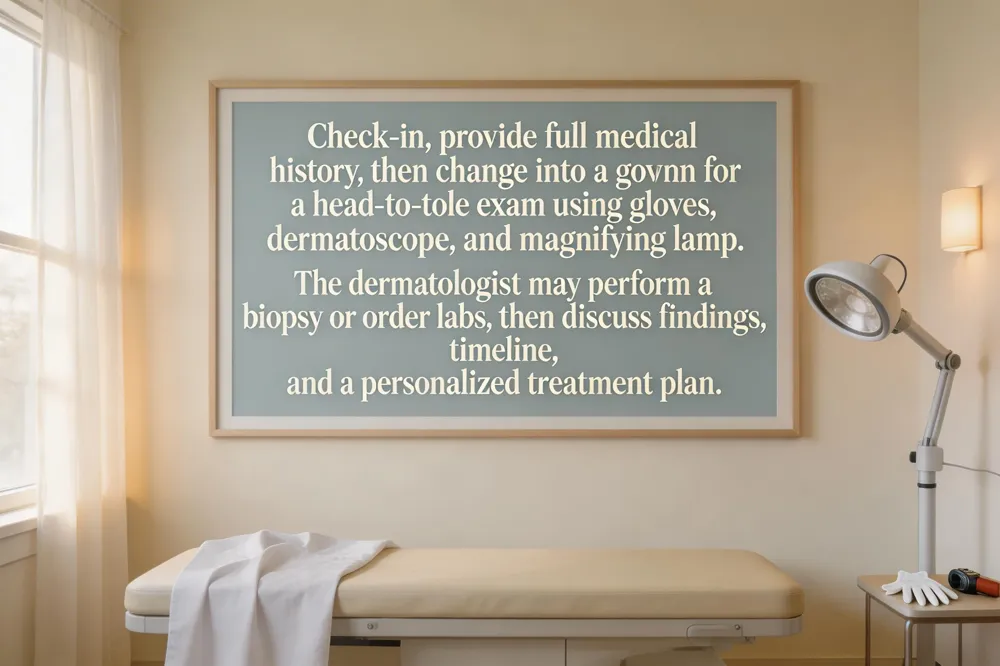 Your initial appointment with a board‑certified dermatologist is a comprehensive, patient‑centered evaluation. First, you will check in and provide your medical history, including family skin‑condition history, sun exposure, medications, allergies, and current skin‑care products. This review helps the clinician understand risk factors for acne, eczema, psoriasis, rosacea, hair loss, and skin cancer.
Next, you will change into a loose‑fitting gown and the doctor will conduct a head‑to‑toe skin examination, often using gloves, a dermatoscope, and a magnifying lamp to assess the face, scalp, nails, and every body surface. Full‑body exams are standard even when the visit is for a specific concern because early detection of skin cancer and other conditions is a key goal.
If a lesion appears suspicious, the dermatologist may perform an in‑office skin biopsy after obtaining consent and applying a local anesthetic. Additional diagnostic tools such as skin swabs, patch tests, or blood work may be ordered to refine the diagnosis.
After the exam, the doctor discusses findings, explains any biopsy results timeline, future, and outlines a personalized treatment plan that fits your lifestyle and goals. This plan may include prescription topicals or oral medications, procedural interventions (e.g., chemical peels, laser therapy), lifestyle recommendations, and a clear follow‑up schedule.
What do they do at your first dermatologist appointment? The visit includes medical‑history review, a full‑body exam, possible biopsies, and a tailored treatment roadmap with preventive advice.
What to expect at your first dermatologist appointment for skin cancer? The dermatologist screens the entire skin surface, uses a dermatoscope for suspicious spots, may perform a same‑day biopsy, and then provides risk‑based counseling, sun‑protection strategies, and a monitoring plan.
What to expect at a dermatology appointment for acne? After history and exam, the doctor diagnoses acne type, discusses triggers, and creates a personalized regimen that can include prescription topicals, oral meds, lifestyle changes, and in‑office procedures like peels or extractions.
What to expect at a dermatologist appointment for psoriasis? The clinician evaluates skin, scalp, nails, and joints, explains disease severity, and proposes a plan that may involve topicals, phototherapy, systemic agents, and lifestyle guidance.
What to expect at a dermatologist appointment for a mole? The mole is examined with a dermatoscope; if worrisome, a biopsy or removal is performed, followed by after‑care instructions and a follow‑up schedule for ongoing skin monitoring.
Key Questions to Ask Your Dermatologist
 When you meet your dermatologist for the first time, start by asking about your personal skin history and any risk factors, such as family history of skin cancer, sun‑exposure habits, or recent changes in moles. Request a clear explanation of the findings from the full‑body skin exam and ask which areas, if any, need further testing or monitoring. Inquire about the most effective treatment options for your specific concerns—whether it’s acne, eczema, rosacea, hair loss, or cosmetic goals—and how they will fit with your daily routine. Clarify the expected timeline for results, potential side effects, and the follow‑up schedule for medications or procedures. Finally, ask what lifestyle changes, products, or preventive measures you can adopt to maintain healthy skin between visits.
Logistics, Timing, and Costs
 A first dermatologist appointment typically lasts 15‑30 minutes, but complex visits—such as a full‑body skin exam, mole assessment, or acne treatment plan—can extend to 40 minutes or more. Virtual or quick follow‑ups may be shorter, around 10‑15 minutes. Arriving early to complete paperwork and bringing a list of concerns and medications helps keep the visit on schedule.
Cost for a new‑patient visit ranges from $150 to $300 out‑of‑pocket, with some Chicago‑suburban practices reporting $145‑$336. If you have insurance and have met your deductible, co‑pays are usually $20‑$50 for in‑network providers. Fees may vary by location, dermatologist experience, and any extra services such as biopsies or lab tests. Call the office ahead to confirm exact pricing and ask about discounts for uninsured patients.
Most practices, including On The Spot Dermatology, accept self‑referrals for cosmetic or out‑of‑pocket visits. However, many HMO, Medicare, and Medicaid plans still require a primary‑care referral for coverage. Verify your plan’s requirements before scheduling.
Red Flags, Preventive Care, and Lifestyle Habits

What is a red flag in dermatology?
A red flag is a skin finding that may signal a serious condition and warrants prompt evaluation. Warning signs include a mole or lesion that changes in size, shape, or color, or begins to itch, bleed, or ulcerate—potential indicators of melanoma or other skin cancers. Non‑healing ulcers, painful blistering with mouth or genital sores, rashes accompanied by fever, weight loss, or joint pain, and rapidly spreading, swollen skin with fever (cellulitis or necrotising fasciitis) are also urgent concerns. Seek immediate professional care if any of these appear.
What 7 habits are off limits for dermatologists?
- Skipping a thorough skincare routine.
- Forgoing daily sunscreen.
- Using triple‑antibiotic cream without guidance.
- Popping pimples, especially late at night.
- Introducing two or more new products at once.
- Wearing gel manicures before a visit.
- Over‑exfoliating or using harsh scrubs before the exam.
Preventive skin‑health recommendations
- Apply broad‑spectrum SPF 30+ daily and reapply every two hours outdoors.
- Perform a monthly self‑exam, noting any new or changing lesions.
- Keep a list of medications, supplements, and skin‑care products to share with your dermatologist.
- Wear loose, makeup‑free clothing to appointments for an unobstructed exam.
- Schedule an annual full‑body skin check and earlier if you have risk factors (family history, high sun exposure, etc.).
Your Path to Healthy, Confident Skin
Before you step into your first appointment, remember to bring a photo ID, insurance card, and a written list of medications, supplements, and any recent skin changes. Arrive with clean, makeup‑free skin and wear loose, easily removable clothing so the dermatologist can perform a thorough head‑to‑toe exam, including scalp, nails, and any areas of concern. Bring photos of suspicious spots and a notebook of questions—this helps the doctor address every issue and create a personalized care plan.
During the visit, expect a detailed medical‑history review, a full‑body skin examination using a dermatoscope, and discussion of treatment options ranging from topical meds to in‑office procedures such as biopsies, chemical peels, or laser therapy. Ask about prevention, lifestyle tweaks, and follow‑up timing; staying proactive empowers you to manage skin health effectively.
Ready to start? Call (815) 941‑5160 or use the online form to schedule your first appointment with On The Spot Dermatology and take the first step toward healthier, more confident skin.