Introduction
Sunscreen, like any over‑the‑counter medication, is required by the U.S. Food and Drug Administration to retain its labeled Sun Protection Factor (SPF) for at least three years from the date of manufacture. Most products display an expiration date; if none is printed, the purchase date should be recorded and the bottle discarded after three years. Heat, direct sunlight, and prolonged exposure to air accelerate the breakdown of both chemical and mineral UV‑filter ingredients, causing visible changes such as clumping, discoloration, or an off‑odor. When a sunscreen’s active ingredients degrade, its SPF drops, providing less protection against UVA and UVB rays. This loss of efficacy increases the risk of sunburn, premature skin aging, DNA damage, and skin cancer, making proper storage and timely replacement essential for optimal skin health.
Understanding Expiration and Shelf Life
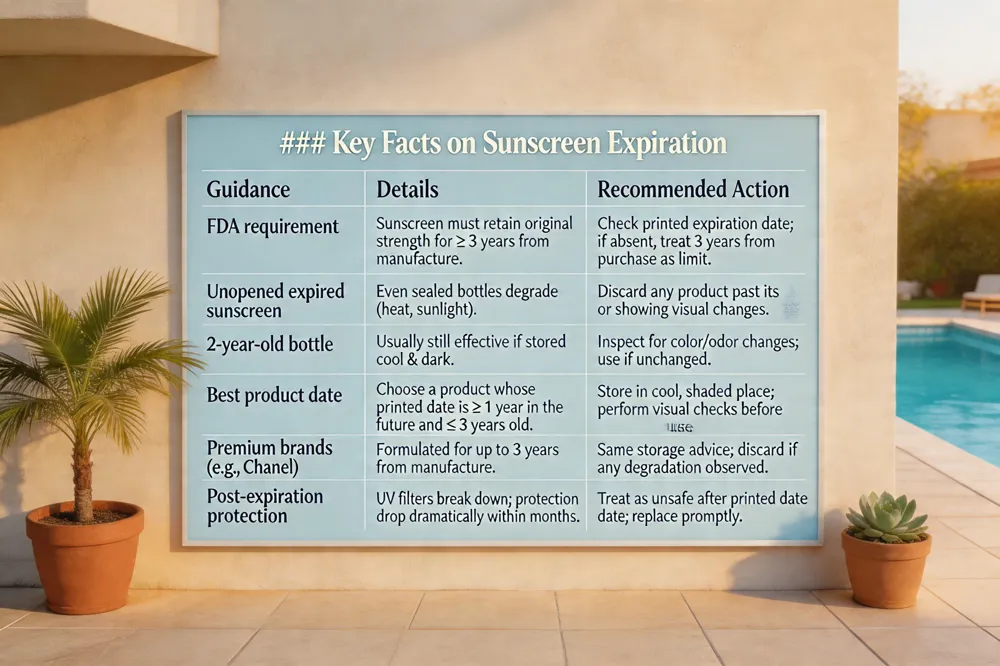
Key Facts on Sunscreen Expiration
| Guidance | Details | Recommended Action |
|---|---|---|
| FDA requirement | Sunscreen must retain original strength for ≥ 3 years from manufacture. | Check printed expiration date; if absent, treat 3 years from purchase as limit. |
| Unopened expired sunscreen | Even sealed bottles degrade (heat, sunlight). | Discard any product past its date or showing visual changes. |
| 2‑year‑old bottle | Usually still effective if stored cool & dark. | Inspect for color/odor changes; use if unchanged. |
| Best product date | Choose a product whose printed date is ≥ 1 year in the future and ≤ 3 years old. | Store in cool, shaded place; perform visual checks before each use. |
| Premium brands (e.g., Chanel) | Formulated for up to 3 years from manufacture. | Same storage advice; discard if any degradation observed. |
| Post‑expiration protection | UV filters break down; protection can drop dramatically within months. | Treat as unsafe after printed date; replace promptly. |
 The U.S. Food and Drug Administration (FDA) requires sunscreen to retain its original strength for at least three years from the date of manufacture. More information
Most brands print an expiration date on the container; if none is shown, write the purchase date on the bottle and treat the product as expired after three years. See details
Can I use unopened expired sunscreen? No. Even sealed bottles can degrade after the printed date—heat, sunlight, and time cause separation, discoloration, or off‑odors, reducing SPF and possibly irritating skin. Heat and sunlight accelerate breakdown and visible changes indicate degradation. Discard any product past its date or showing visual changes.
Does sunscreen expire after 2 years? Not automatically. The FDA’s three‑year guarantee applies, but a two‑year‑old bottle is generally still effective if stored cool, dark, and unchanged. FDA three‑year guarantee. Once the expiration date passes, protection may drop dramatically.
Best sunscreen expiration date Choose a product whose printed date is at least one year in the future and no older than three years from manufacture. Store it in a cool, shaded place and inspect for color, texture, or odor changes before each use. Cool, shaded storage and visual checks
How long does Chanel sunscreen last? Like most premium brands, Chanel sunscreen is formulated for up to three years from manufacture. Three‑year shelf life Proper storage (cool, dry, away from direct sun) preserves its SPF; any visual degradation warrants disposal. Cool, dry storage
How long after expiration is sunscreen still good? After the printed date, active UV filters begin to break down; protection can fall within months. UV filters degrade after expiration If no date is printed, treat three years from purchase as the safe limit and discard if the product looks or smells off. Three‑year safe limit
Spotting Degraded Sunscreen
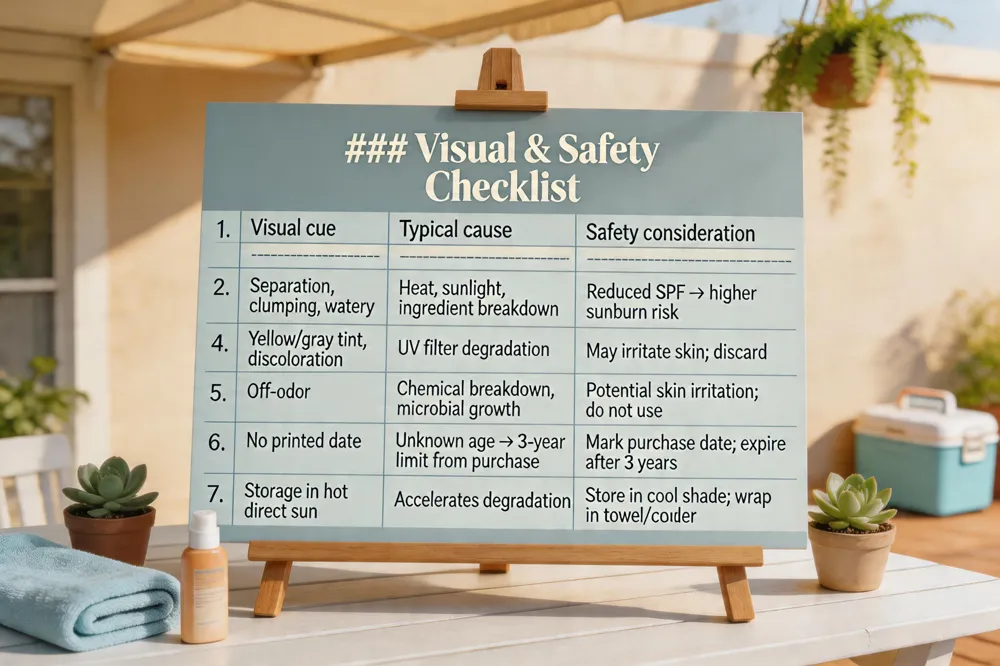
Visual & Safety Checklist
| Visual cue | Typical cause | Safety consideration |
|---|---|---|
| Separation, clumping, watery consistency | Heat, sunlight, time cause ingredient breakdown. | Reduced SPF → higher sunburn risk. |
| Yellow/gray tint, discoloration | UV filter degradation. | May irritate skin; discard. |
| Off‑odor | Chemical breakdown, possible microbial growth. | Potential skin irritation; do not use. |
| No printed date | Unknown age → assume 3‑year limit from purchase. | Mark purchase date; treat as expired after 3 years. |
| Storage in hot, direct sun | Accelerates degradation. | Store in cool, shaded place; wrap in towel or cooler. |
 The FDA requires sunscreen to retain its labeled strength for at least three years from manufacture, but heat, direct sunlight, and time can accelerate ingredient breakdown.
Visual cues of product breakdown – Look for separation, clumping, discoloration, or an off‑odor. A yellow or gray tint, grainy texture, or watery consistency signals that the UV filters have degraded.
Impact of storage – Storing bottles in a cool, shaded place, preferably wrapped in a towel or kept in a cooler slows degradation. Exposure to high temperatures or direct sun can cause the same changes even before the printed date.
Safety considerations – Using a compromised formula reduces SPF, leaving skin vulnerable to sunburn, premature aging, and skin cancer. It may also irritate sensitive skin or trigger allergic reactions.
How to tell if sunscreen is expired? Check the printed expiration date; if it has passed, discard the product. If no date is shown, treat the sunscreen as expired three years after purchase. Inspect for color, texture, or odor changes, and consider storage conditions. When in doubt, replace it.
What happens if we use expired sunscreen? The UV‑filter ingredients lose potency, so the product no longer blocks UVA/UVB effectively. The formula may separate, making even application difficult, and it can irritate skin.
What to do with expired sunscreen? Do not reuse for sun protection. Place the tube in regular trash (do not flush). Many pharmacies or local hazardous‑waste programs accept unopened or partially used sunscreen for proper disposal; recycle the empty container according to local guidelines.
Is it safe to use expired sunscreen on the face? No. Facial skin is thin and sensitive; a degraded sunscreen can provide insufficient protection and cause irritation.
Sunscreen expiration date code Manufacturers often embed a batch/lot code that can be decoded online to reveal the manufacturing and expiration dates. In the U.S., the FDA recommends a three‑year shelf life. If the code is unclear, contact the brand or discard the product if it shows any signs of spoilage.
Sun Safety Essentials
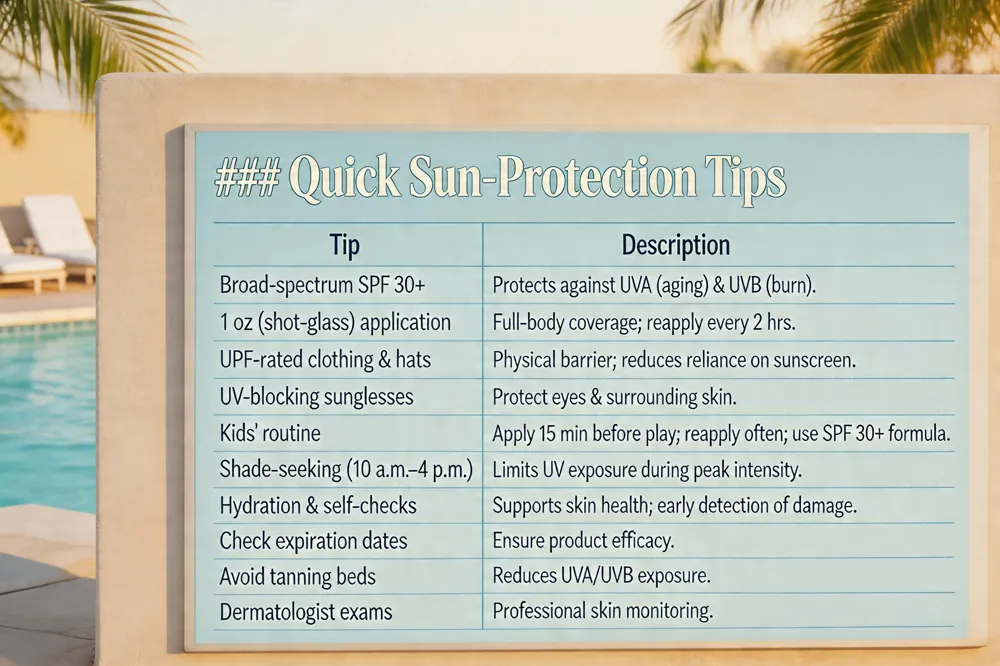
Quick Sun‑Protection Tips
| Tip | Description |
|---|---|
| Broad‑spectrum SPF 30+ | Protects against UVA (aging) & UVB (burn). |
| 1 oz (shot‑glass) application | Full‑body coverage; reapply every 2 hrs. |
| UPF‑rated clothing & hats | Physical barrier; reduces reliance on sunscreen. |
| UV‑blocking sunglasses | Protect eyes & surrounding skin. |
| Kids' routine | Apply 15 min before play; reapply often; use SPF 30+ formula. |
| Shade‑seeking (10 a.m.–4 p.m.) | Limits UV exposure during peak intensity. |
| Hydration & self‑checks | Supports skin health; early detection of damage. |
| Check expiration dates | Ensure product efficacy. |
| Avoid tanning beds | Reduces UVA/UVB exposure. |
| Dermatologist exams | Professional skin monitoring. |
 Choosing a broad‑spectrum sunscreen with at least SPF 30 protects against both UVA (aging and cancer) and UVB (sunburn) rays. Apply roughly one ounce (the size of a shot glass) for full‑body coverage and reapply every two hours, or sooner after swimming, sweating, or toweling off. Pair sunscreen with UPF‑rated clothing, wide‑brimmed hats, and UV‑blocking, wrap‑around sunglasses for layered defense.
For kids, use the same SPF 30+ broad‑spectrum formula, applying 15 minutes before play and reapplying regularly. Dress children in tightly woven, lightweight garments with a UPF label, and keep infants under six months out of direct sun, using protective clothing and only a thin layer of sunscreen on any exposed skin.
Key sun‑safety facts: UVB causes sunburn; UVA penetrates deeper, driving premature aging and skin cancer. Even on cloudy days, up to 80 % of UV can reach skin, especially on reflective surfaces. Shade‑seeking between 10 a.m. and 4 p.m., staying hydrated, and regular skin self‑checks complement sunscreen use.
Ten quick protection tips: 1) Apply sunscreen 20 minutes before exposure; 2) Wear UPF clothing; 3) Seek shade; 4) Stay hydrated; 5) Check expiration dates; 6) Avoid tanning beds; 7) Use protective hats and sunglasses; 8) Reapply after water exposure; 9) Cover often‑missed areas (ears, neck, hands); 10) Schedule dermatologist exams.
Natural & Complementary Protection
Complementary Strategies for Skin Defense
| Strategy | How to Implement |
|---|---|
| Peak‑hour avoidance | Stay indoors or in shade 10 a.m.–4 p.m. |
| UPF clothing | Wear tightly‑woven, loose‑fitting garments with high UPF rating. |
| Antioxidant‑rich diet | Include berries, citrus, leafy greens, nuts, fatty fish (vit C/E, β‑carotene, ω‑3). |
| Hydration | Drink plenty of water; keep skin moisturized. |
| Mineral‑based sunscreen | Choose zinc oxide or titanium dioxide formulas for natural broad‑spectrum protection. |
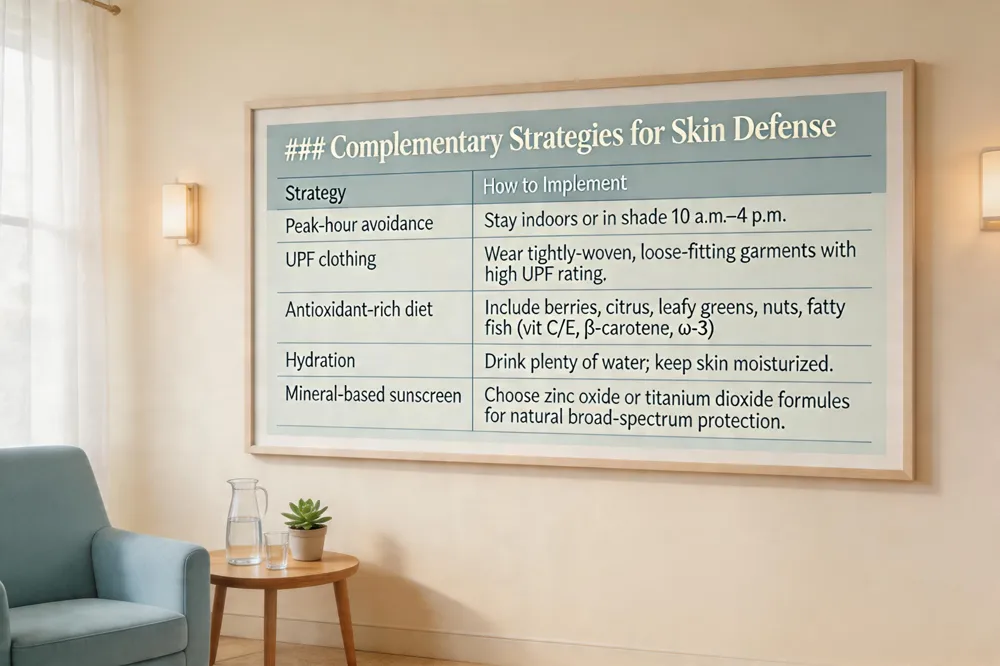 To shield your skin naturally, start by limiting exposure during the sun’s peak hours (10 a.m.–4 p.m.) and seek shade whenever possible. Wear loose‑fitting, tightly‑woven clothing, wide‑brimmed hats, and UV‑blocking sunglasses, or choose garments with a high UPF rating to block the rays before they reach your skin. Incorporate antioxidant‑rich foods such as berries, citrus, leafy greens, nuts, and fatty fish into your diet, because vitamins C and E, beta‑carotene, and omega‑3 fatty acids help neutralize UV‑induced free radicals. Keep your skin well‑hydrated and moisturized to maintain a strong barrier, and drink plenty of water throughout the day. Finally, consider using mineral‑based sunscreens containing zinc oxide or titanium dioxide, which sit on the skin’s surface and provide a natural, broad‑spectrum shield without chemical additives. Together, these strategies—dietary antioxidants, UPF clothing, peak‑hour avoidance, and proper hydration—create a comprehensive, skin‑friendly defense against harmful ultraviolet radiation.
Facial Risks and Decision Making
Facial Sunscreen Decision Guide
| Risk | Advice |
|---|---|
| Expired product on face | Do not use – thin facial skin is more vulnerable to reduced SPF and irritation. |
| Choosing between expired vs. none | Prefer no sunscreen; seek shade, wear protective clothing, limit outdoor time until a fresh product is obtained. |
| Application amount | ~1 teaspoon (≈ 5 ml) for face neck. |
| Reapplication frequency | Every 2 hrs, or after swimming/sweating/towel‑drying. |
| Storage | Cool, shaded place to preserve efficacy up to 3 years. |
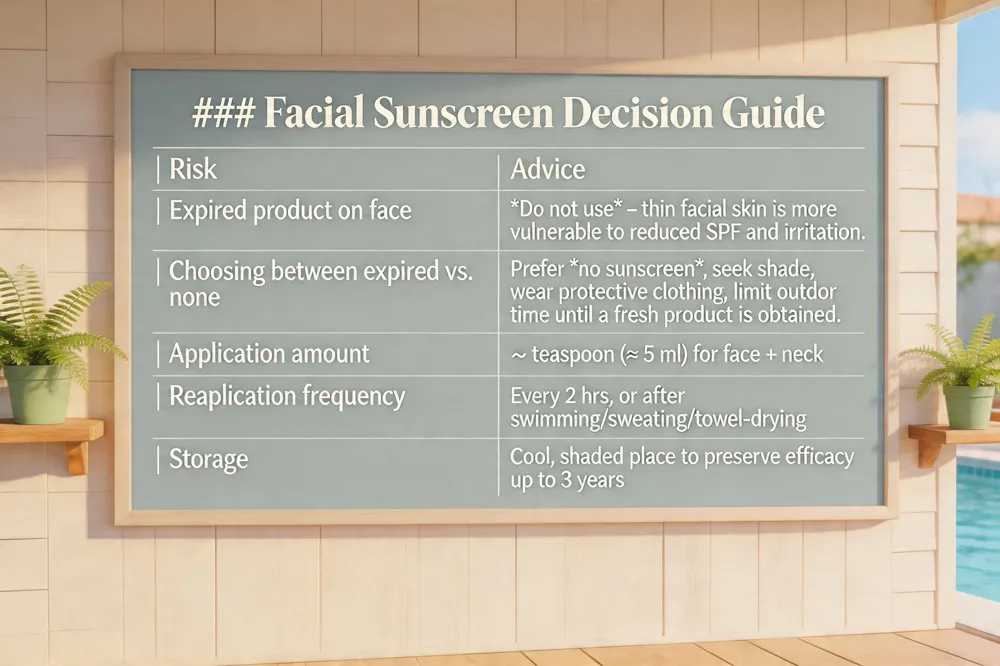 Sunscreen that has passed its printed expiration date should not be used on the face. The FDA requires that sunscreen retain its labeled SPF for at least three years; after that, active ingredients—especially in chemical formulas—degrade, lowering UV protection and increasing the risk of sunburn, premature aging, and skin cancer. Facial skin is thinner and more sensitive, so a compromised product can also cause irritation or uneven coverage. Visible signs of degradation such as color change, clumping, separation, or an off‑odor indicate the product should be discarded and replaced with a fresh, properly stored bottle.
If you must choose between an expired sunscreen and no sunscreen at all, the safer option is to for the expired product. An expired formula may provide only a fraction of its labeled SPF and can give a false sense of security, potentially leading to longer sun exposure and skin damage. Instead, seek shade, wear protective clothing and UV‑blocking sunglasses, and limit time outdoors during peak UV hours until you can obtain a new sunscreen.
For facial application, reapply every two hours, and immediately after swimming, sweating, or towel‑drying. Use roughly one teaspoon (≈ 5 ml) for the entire face and neck, choosing a broad‑spectrum, water‑resistant product that matches your skin type. Store sunscreen in a cool, shaded place to preserve its efficacy for up to three years.
Disposal and Environmental Impact
Safe Disposal & Recycling Steps
| Disposal method | Steps |
|---|---|
| Regular trash | 1. Keep sunscreen in original container. 2. Wipe off residue. 3. Place unopened/partially used tube in household trash. |
| Recycling (plastic, glass, metal) | 1. Rinse container lightly. 2. Sort according to local recycling rules. 3. Dispose in curbside recycling if accepted. |
| Hazardous‑waste programs | 1. Locate pharmacy or municipal drop‑off. 2. Bring unopened or partially used sunscreen. 3. Follow program guidelines for special handling. |
| Environmental note | UV filters can harm aquatic ecosystems; proper disposal prevents water contamination. |
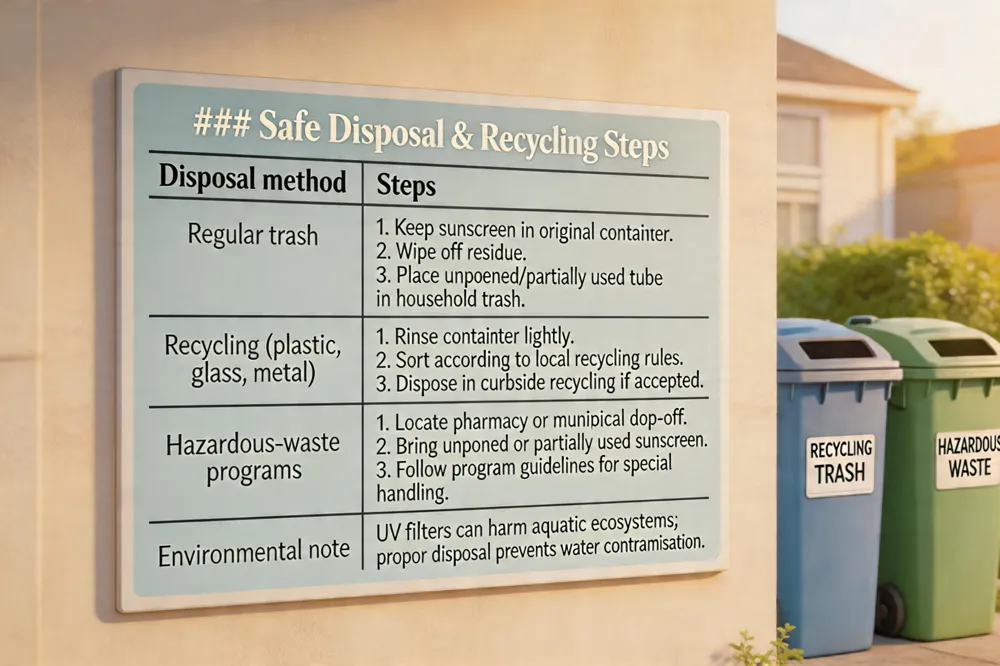 Proper trash disposal is the simplest and safest method for expired sunscreen. Because the UV filters lose potency and may irritate skin, the product should never be used for sun protection. Keep the sunscreen in its original container, wipe off any residue, and place the unopened or partially used tube in the regular household trash—do not pour the liquid down a sink or toilet, as sunscreen chemicals can harm aquatic ecosystems.
Recycling guidelines for containers depend on the material. Empty, clean plastic bottles, glass jars, or metal tins can be placed in the curbside recycling stream if your local program accepts them. Rinse the container lightly to remove residue, then sort it according to your municipality’s plastic, glass, or metal recycling categories. If the container is not recyclable, dispose of it in the trash.
Many communities offer hazardous‑waste programs that accept unopened or partially used sunscreen for special handling. Check with local pharmacies, waste‑management agencies, or municipal “take‑back” events for drop‑off locations. These programs prevent sunscreen chemicals from entering landfills and waterways.
Sunscreen expiration date code: Most sunscreens display a batch or lot code that encodes the manufacturing date. Manufacturers often provide an online decoder or chart where you can enter the code to determine the exact production and expiration dates. In the United States, The FDA requires sunscreen to retain original strength for at least three years from manufacture date. If a product lacks a printed date, The “period after opening” (PAO) symbol—an jar with a lid and a number of months—indicates how long the product remains potent after being opened. When in doubt, discard any sunscreen that shows discoloration, an off‑smell, or is past its printed expiration date to ensure optimal protection and to protect the environment.
Conclusion
Sunscreen must retain its labeled SPF for at least three years from manufacture; the FDA requires an expiration date, and if none is printed you should write the purchase date and discard the product after three years. Heat, direct sunlight, and humidity accelerate ingredient breakdown, so store every in a cool, shaded place and keep the lid tightly closed. Before each use, inspect the texture, color, and odor—separation, clumping, yellowing, or an off‑smell signal degradation and the bottle should be tossed. Apply roughly one ounce (a shot‑glass) for full‑body coverage, reapply every two hours or after swimming or sweating, and replace any sunscreen that is past its date or shows visual changes. These simple steps ensure consistent UV protection and reduce the risk of sunburn, photo‑aging, and skin cancer.