A New Era in Hair‑Loss Management
Androgenetic alopecia (AGA) remains the most common form of hair loss, affecting up to 50 % of men and 40 % of women by age 50. The current therapeutic landscape includes FDA‑approved minoxidil (topical) and finasteride (oral) that prolong the anagen phase and block DHT, respectively, as well as surgical Folular unit extraction (FUE) transplants for permanent restoration. Early intervention is critical because once follicles are irreversibly miniaturized, regenerative options lose efficacy; treating before extensive follicular loss improves both pharmaceutical and surgical outcomes. 2026 sees a surge in biologic and cellular approaches that go beyond hormone modulation. Autologous platelet‑rich plasma (PRP) delivers growth factors (PDGF, VEGF, IGF‑1) to reactivate dormant follicles, while next‑generation PRP 2.0 adds leukocytes and fibrin matrices for sustained release. Novel small‑molecule agents such as PP405 target follicle stem‑cell pathways, and emerging stem‑cell‑derived exosomes and adipose‑derived cell grafts aim to regenerate the follicular niche. These advances promise more personalized, less invasive regrowth strategies, especially when combined with established minoxidil or finasteride regimens.
Platelet‑Rich Plasma 2.0: Science, Protocols, and Clinical Impact
 Platelet‑Rich Plasma (PRP) therapy concentrates the patient’s own platelets—typically 2‑6‑fold above baseline—to deliver growth factors such as PDGF, VEGF, FGF, TGF‑β, IGF‑1, and EGF. These molecules prolong the anagen phase, stimulate dermal‑papilla proliferation, and improve scalp microcirculation.
PRP 2.0 builds on the first‑generation technique by using double‑spin centrifugation for higher platelet doses, adding platelet‑rich fibrin (PRF) for a sustained release matrix, and pairing injections with microneedling or low‑level laser therapy to boost follicular stem‑cell activation.
A consensus regimen now includes three to four monthly induction sessions (4‑6 weeks apart) followed by maintenance injections every 4‑6 months.
Studies report 10‑30 % increases in hair density and 22‑30 % gains in shaft thickness after the induction phase, with longevity maintained through yearly boosters.
Meta‑analyses of randomized trials (2023‑2025) show a mean density gain of 27.5 hairs/cm² (≈ 15‑35 % improvement) and modest increases in shaft diameter, though heterogeneity remains high.
Real‑world data echo these trends, especially when PRP is combined with minoxidil, finasteride, or hair‑transplant grafts, where graft survival rises by ~15 %.
Answer to "Hair loss treatment new research": Recent work pivots from classic drugs toward biologics and cell‑based therapies. UCLA’s PP405 molecule awakens dormant follicle stem cells, delivering statistically significant terminal‑hair regrowth in early human trials.
Parallel advances include antibody‑based pathway inhibitors and stem‑cell‑derived exosomes, all aiming for durable, personalized restoration beyond the limits of minoxidil and finasteride.
PP405 – Reactivating Dormant Follicles
 Mechanism of action (Wnt/β‑catenin activation)
PP405 is a small‑molecule topical developed by Pelage Pharmaceuticals that blocks a protein that keeps follicle stem cells in a dormant state. By releasing this brake, the drug re‑engages the Wnt/β‑catenin pathway, prompting stem cells in the bulge region to re‑enter the anagen (growth) phase and produce terminal hairs rather than fine vellus hairs.
Mechanism of action (Wnt/β‑catenin activation)
PP405 is a small‑molecule topical developed by Pelage Pharmaceuticals that blocks a protein that keeps follicle stem cells in a dormant state. By releasing this brake, the drug re‑engages the Wnt/β‑catenin pathway, prompting stem cells in the bulge region to re‑enter the anagen (growth) phase and produce terminal hairs rather than fine vellus hairs.
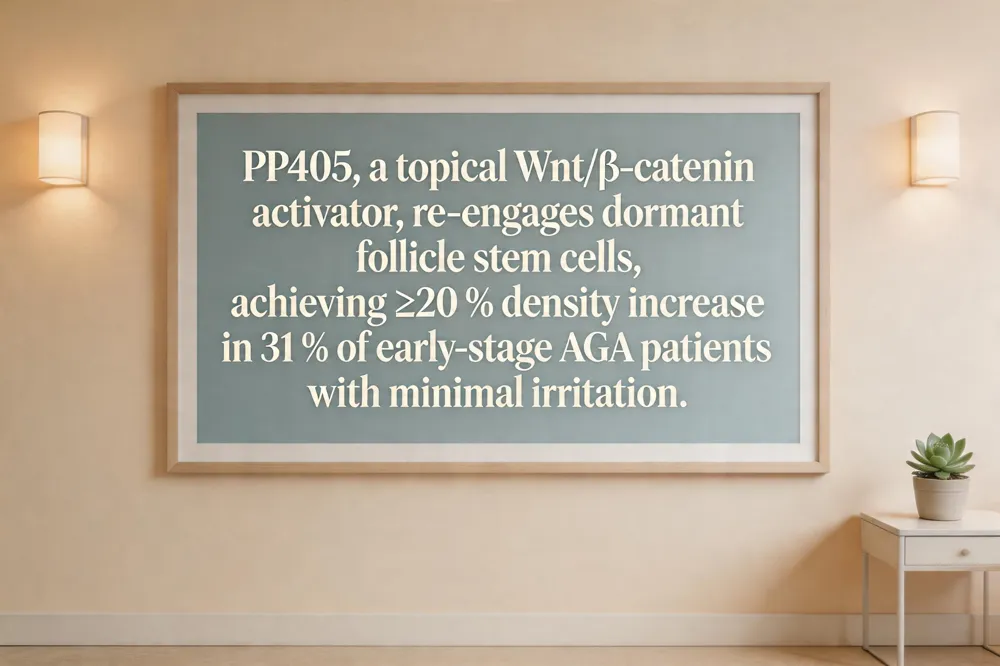
Phase 2a trial results and safety profile In a randomized Phase 2a study of 78 men with early‑stage androgenetic alopecia, 31 % of participants using PP405 showed a ≥20 % increase in hair density after eight weeks, versus 0 % in the placebo group. Biopsies demonstrated follicular re‑activation within seven days. No systemic absorption was detected and adverse events were limited to mild scalp irritation, confirming an excellent safety record.
Target patient population (early‑stage thinning) PP405 works only on viable but dormant follicles; thus the ideal candidates are individuals with mild to moderate diffuse thinning where follicles have not yet undergone irreversible miniaturization or scarring.
Regulatory status and timeline for market entry PP405 remains investigational; it is not FDA‑approved and is still in late‑stage clinical testing. Based on current trial progress, market availability in the United States is projected within 12‑18 months, pending regulatory review.
PP405 hair loss treatment PP405 aims to reactivate dormant follicles, offering a non‑systemic alternative to finasteride or minoxidil. Until FDA approval, proven therapies remain the first‑line options, though enrollment in clinical trials may be appropriate for select patients.
New hair loss treatment coming soon PP405, with its >20 % density gain in early trials, is expected to launch within the next year, alongside an extended‑release oral minoxidil formulation (VDPHL01) that promises faster, steadier results.
Latest hair loss treatment for men For men, PP405 represents the newest regenerative breakthrough, delivering follicle activation without systemic exposure, while the time‑release minoxidil (VDPHL01) offers an improved pharmacokinetic profile for faster regrowth.
Clascoterone 5 % Topical – First‑in‑Class Anti‑Androgen
 Clascoterone 5 % topical solution represents a breakthrough in the treatment of male androgenetic alopecia by delivering a local androgen‑receptor blockade directly to the scalp. Unlike oral finasteride, the drug works at the follicular level without systemic absorption, thereby minimizing the risk of hormonal side effects. In two identical Phase 3 trials involving a total of 1,465 men, clascoterone produced remarkable hair‑count increases—one study reported a 539 % rise and the other a 168 % rise in target‑area hair density compared with vehicle. Participants also reported high satisfaction and visible regrowth as early as two months. The safety profile was comparable to placebo, with only mild, transient skin irritation and no measurable changes in serum testosterone or DHT. An ongoing safety follow‑up is expected to be completed later this year, after which the sponsor plans to submit a New Drug Application. If approved, clascoterone could become the first new, first‑in‑class topical anti‑androgen for hair loss in over three decades, offering a non‑systemic alternative to existing therapies.
Extended‑Release Oral Minoxidil (VDPHL01) – Faster, Safer Growth
 VDPHL01 is an extended‑release oral minoxidil formulation that maintains a steadier plasma concentration than traditional immediate‑release pills. By avoiding high peak levels, the drug provides continuous K‑ATP channel activation, prolonging the anagen phase while minimizing the chest‑tightness, palpitations, and headaches that can accompany standard oral minoxidil. Clinical data from a Phase 3 retrospective IGA analysis showed visible hair‑growth improvement at two months, whereas conventional oral or topical minoxidil typically requires four to six months to produce comparable results. This accelerated timeline is attributed to the more stable drug exposure, which supports sustained VEGF expression and microcirculation without the rapid plasma spikes of standard formulations. Compared with conventional oral minoxidil, VDPHL01 a lower incidence of systemic side effects, making it a safer option for patients who are sensitive to cardiovascular symptoms.
New hair loss treatment 2026: In 2026, breakthrough therapies such as Pelage Pharmaceuticals’ PP405— a topical molecule that reactivates dormant follicles, achieving >20 % density gains in 31 % of users after four weeks—and the time‑released oral minoxidil VDPHL01, which shortens visible regrowth to two months, are poised to expand the therapeutic arsenal beyond finasteride and traditional minoxidil.
New hair loss treatment coming soon: PP405, a regenerative topical agent, is in late‑stage trials with a Phase 2a study showing ≥20 % density increase in 31 % of participants after four weeks and no systemic absorption. VDPHL01’s steady‑state exposure promises faster results and fewer side effects, offering patients a more efficient and tolerable alternative to existing treatments.
Clinical‑Trial Landscape: What’s Recruiting and What It Means for Patients
 Recent Phase 3 data have reignited optimism for new hair‑loss therapies. Cosmo Pharmaceuticals reported that the topical steroid clascoterone boosted hair density in men with androgenetic alopecia by 168 % to 539 % versus placebo, prompting planned U.S. and European filings. In parallel, Pelage Pharmaceuticals’ PP405, a small‑molecule that reactivates dormant follicle stem cells, showed a >20 % density increase in a Phase 2a trial and is now entering a multinational recruiting study in Melbourne that enrolls adults with stages III‑V AGA to assess safety and tolerability. Emerging modalities expanding beyond traditional drugs: exosome‑based injections aim to deliver regenerative vesicles; stem‑cell‑rich fat grafts provide a local source of regenerative cells; and antibody biologics (e.g., dupilumab) target specific inflammatory pathways implicated in alopecia. Patients eager to join trials should first discuss eligibility with their dermatologist, who can evaluate disease stage, medical history, and concurrent therapies. They can also search ClinicalTrials.gov using keywords such as “androgenetic alopecia 2025/2026” or contact academic centers listed in the study advertisements to learn about enrollment timelines and geographic sites.
Celebrity Spotlight: Matthew McConaughey’s Hair‑Care Routine
 Public statements about his regimen
In multiple interviews, Matthew McConaughey has openly discussed his concerns about early‑onset thinning that began in the late 1990s. He emphasizes a disciplined, non‑surgical approach, crediting a daily topical treatment as the primary driver of his restored hair density. McConaughey repeatedly stresses that consistency and proper scalp care—not quick fixes—have been key to his results.
Public statements about his regimen
In multiple interviews, Matthew McConaughey has openly discussed his concerns about early‑onset thinning that began in the late 1990s. He emphasizes a disciplined, non‑surgical approach, crediting a daily topical treatment as the primary driver of his restored hair density. McConaughey repeatedly stresses that consistency and proper scalp care—not quick fixes—have been key to his results.
The product Regenix and its claimed mechanism Regenix is marketed as a proprietary topical ointment that delivers a blend of peptides, growth‑factor mimetics, and vasodilatory agents directly to the scalp. According to the manufacturer, these ingredients work by:
- Enhancing microcirculation to deliver oxygen and nutrients to hair follicles.
- Extending the anagen (growth) phase of the hair cycle.
- Stimulating dormant follicular stem cells to re‑enter the growth cycle, similar to the way platelet‑rich plasma (PRP) releases growth factors such as PDGF, VEGF, and IGF‑1. The formulation is designed for daily application, allowing the active compounds to accumulate and exert a cumulative regenerative effect over months.
Why he denies surgical transplantation McConaughey has consistently denied having undergone any hair‑transplant procedures, such as Follicular Unit Extraction (FUE). He cites two main reasons:
- Preference for minimally invasive, autologous solutions – Like PRP therapy, Regenix leverages the body’s own biology without the need for surgical incisions, donor‑site scarring, or graft survival concerns.
- Philosophical stance on natural restoration – He believes that a non‑surgical regimen aligns better with his lifestyle and avoids the permanent alteration of scalp anatomy that surgery entails.
Take‑away lessons for patients
- Early intervention matters – Initiating treatment before irreversible follicular miniaturization yields better outcomes, a principle echoed across PRP, minoxidil, finasteride, and emerging topical agents like Regenix.
- Consistency is critical – Daily application over an extended period is necessary to see measurable improvements in hair density and thickness.
- Combine modalities when appropriate – Evidence shows that adjunctive therapies (e.g., PRP, low‑level laser therapy, or topical minoxidil) can enhance graft survival and overall density, suggesting a multimodal approach may be optimal.
- Personalized care – Patients should work with board‑certified dermatologists to assess scalp health, identify dormant versus permanently lost follicles, and tailor a regimen that balances efficacy with safety.
Answer to the key question What did Matthew McConaughey do to fix his thinning hair? Matthew McConaughey noticed his hair thinning in the late 1990s and chose to address it with a non‑surgical approach. He began applying a daily topical ointment called Regenix to his scalp, adhering to the routine consistently over the years. In interviews he has emphasized that the regimen, along with proper scalp care, was the sole driver of his regrowth. McConaughey has repeatedly denied having a hair‑transplant surgery, attributing his denser hair to the Regenix treatment. His commitment to the daily application is what he credits for restoring the fullness of his hair.
Combining Therapies: PRP, Microneedling, LLLT, and Medications
 Synergy between PRP and topical minoxidil/finasteride is now a cornerstone of personalized hair‑restoration. PRP delivers autologous growth factors that reactivate dormant follicle stem cells, while minoxidil extends the anagen phase and finasteride reduces DHT‑driven miniaturization; together they produce greater increases in density than either alone. Low‑Level Laser Therapy (LLLT) and microneedling serve as adjunctive boosters—LLLT improves scalp microcirculation and stimulates cellular metabolism, whereas microneedling creates micro‑channels that enhance topical drug and PRP penetration. In transplant patients, PRP applied intra‑operatively and during post‑operative maintenance has been shown to raise graft survival by roughly 15 % and improve overall follicular unit density. A practical, personalized regimen might begin with three monthly PRP sessions combined with daily minoxidil 5 % and oral finasteride 1 mg, followed by microneedling (0.5 mm) and LLLT twice weekly for six weeks, then maintenance PRP every 6–12 months. This multimodal approach leverages complementary mechanisms to maximize follicle health, scalp vascularity, and long‑term regrowth outcomes.
Putting It All Together for Your Scalp Health
Platelet‑rich plasma 2.0 (PRP 2.0) builds on classic PRP by using higher platelet concentrations, optional leukocyte enrichment, and adjunctive low‑level laser or microneedling to prolong growth‑factor release. Clinical data show 10‑30 % gains in hair density after 3‑4 monthly sessions, especially when combined with minoxidil or finasteride. Emerging molecules such as PP405 – a follicle‑stem‑cell activator that awakens dormant follicles via Wnt/β‑catenin signaling – and the extended‑release oral minoxidil VDPHL01 are still investigational but have demonstrated early density improvements of 20‑30 % in Phase 2 trials.
When choosing a regimen, patients should weigh the proven safety and modest efficacy of FDA‑approved options (topical minoxidil, oral finasteride, dutasteride) against the potential of higher‑impact but still experimental agents (PP405, VDPHL01, PRP 2.0). Factors such as stage of alopecia, tolerance of systemic side effects, and desire for non‑surgical growth guide the decision.
The Spot Dermatology in Glenview, IL, offers comprehensive scalp assessment, trichoscopy, and personalized plans that integrate proven pharmaceuticals, PRP‑2.0, microneedling, and, when appropriate, referral for follicular unit extraction. Their multidisciplinary approach ensures each patient receives the most effective, evidence‑based combination for lasting scalp health.