Why ROI Matters in Skincare
The U.S. beauty and personal‑care market is booming, with the global skincare segment valued at $155 billion in 2023 and projected to reach $210 billion by 2028 ( Statista). Americans now spend roughly $300‑$500 per year on skincare, yet only 30% report noticeable improvements, underscoring the need for evidence‑based purchases. Online channels are reshaping buying habits, accounting for nearly one‑third of beauty sales by 2030 and allowing consumers to compare ingredient transparency and clinical data before committing. Investing in high‑quality, clinically validated products—such as broad‑spectrum sunscreen, vitamin C serums, or retinoid moisturizers—delivers measurable skin‑health benefits, reduces future medical expenses, and enhances the long‑term return on investment for both patients and dermatology practices.
Market Landscape and Economic Scale
| Metric | Value | Year/Period | Notes |
|---|---|---|---|
| U.S. beauty & personal‑care market size | US$107 billion | 2026 | Includes cosmetics, skincare, fragrances, personal‑care, beauty‑tech |
| U.S. beauty & personal‑care market size | US$109.6 billion | 2025 | Modest YoY decline |
| Per‑capita annual spend (U.S.) | US$306 | 2025 | |
| CAGR (2026‑2031) | 2.4 % | 2026‑2031 | Projected growth |
| Online sales share | ≈60 % | 2026 | Of total revenue |
| U.S. dermatology market size | US$552 million | 2025 | |
| U.S. dermatology market size | US$1.04 billion | 2034 | |
| Dermatology CAGR (2025‑2034) | 7.3 % | 2025‑2034 | |
| Global skin‑repair market size | US$90.6 billion | 2025 | |
| Global skin‑repair market size | US$160.5 billion | 2034 | |
| Skin‑repair CAGR (2025‑2034) | 6.6 % | 2025‑2034 | |
| Cosmetic dermatology (dermal fillers) market size | US$8.5 billion | 2025 | |
| Cosmetic dermatology (dermal fillers) market size | US$34.6 billion | 2035 | |
| Dermal‑fillers CAGR (2025‑2035) | ≈15 % | 2025‑2035 | |
| Key drivers | Aging population, demand for minimally invasive aesthetics, personalized skincare & med‑device tech | – | – |
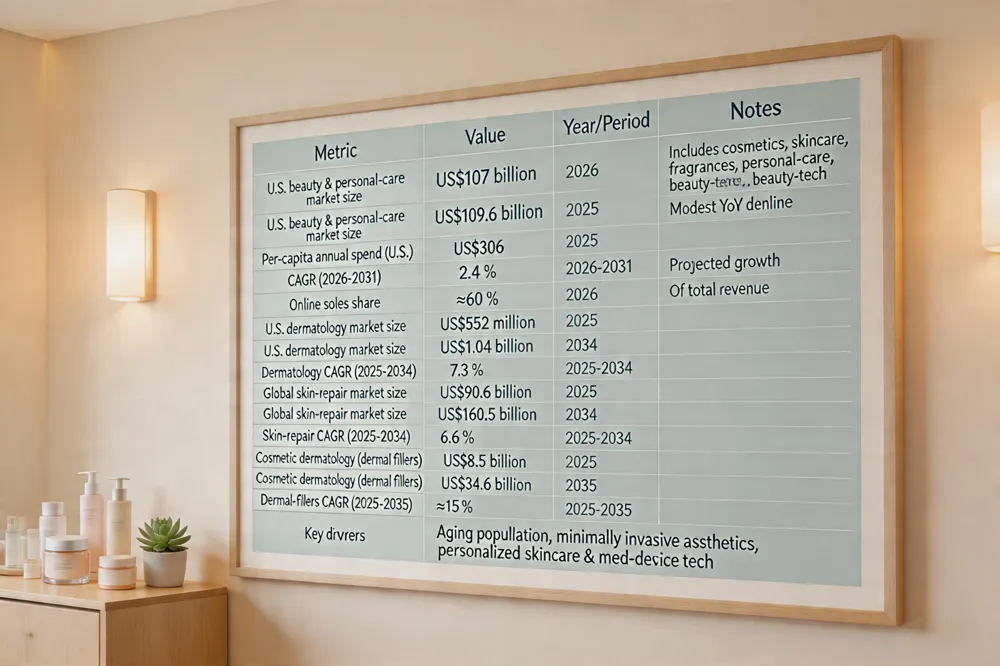 The U.S. beauty and personal‑care market, encompassing cosmetics, skincare, fragrances, personal‑care products and beauty‑tech, is valued at roughly US$107 billion in 2026. In 2025 the market was estimated at about US$109.6 billion, showing modest year‑over‑year growth, which translates to approximately US$306 per person in annual spending. Industry projections indicate a 2.4 % compound annual growth rate through 2031, with online sales now accounting for nearly 60 % of total revenue, highlighting the shift toward digital channels.
The dermatology market is expanding rapidly. In the United States, the sector is projected to grow from USD 552 million in 2025 to roughly USD 1.04 billion by 2034, a CAGR of about 7.3 %. Global skin‑repair products are also on a strong upward trajectory, expected to rise from USD 90.6 billion in 2025 to USD 160.5 billion by 2034 (≈6.6 % CAGR). Cosmetic dermatology, especially dermal fillers, is experiencing the fastest growth, projected to jump from USD 8.5 billion in 2025 to USD 34.6 billion by 2035 (≈15 % CAGR). Drivers include an aging population, rising demand for minimally invasive aesthetic procedures, and advances in personalized skincare and medical‑device technologies.
Understanding ROI Percentages
| ROI % | Profit / Cost | Example (US$1,000 spend) | Interpretation |
|---|---|---|---|
| 20 % | $200 profit | $1,000 spend → $200 profit | Modest efficiency, positive return |
| 30 % | $300 profit | $1,000 spend → $300 profit | Higher yield, more effective use |
| Evidence‑based product regimens | 1.5‑2× ROI vs. single‑procedure | 1,000 spend on regimen → $1,500‑$2,000 ROI | Better cost‑effectiveness |
| Digital marketing campaigns | 2.5× ROI vs. traditional ads | $1,000 spend on digital → $2,500 ROI | Stronger profitability |
| Traditional ads | Baseline | 1,000 spend → $1,000 ROI | Lower relative performance |
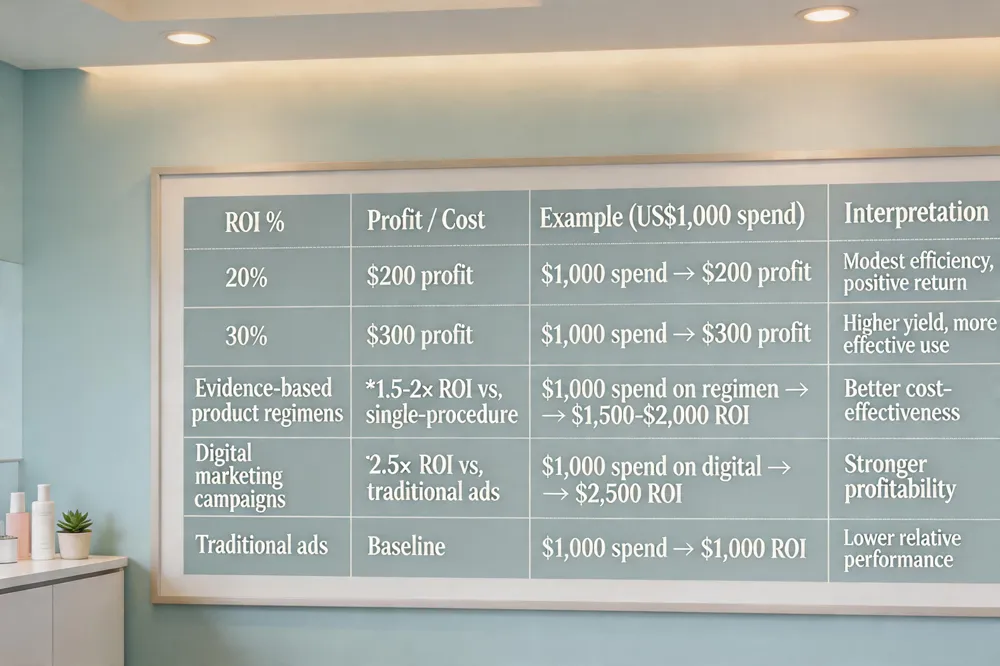 Return on investment (ROI) measures how much profit an expense generates relative to its cost, expressed as a percentage: (Net Profit ÷ Total Cost) × 100. A 20 % ROI means the profit equals one‑fifth of the amount spent. For example, a $1,000 spend that yields $200 profit produces a 20 % ROI, indicating modest efficiency but still a positive return. A 30 % ROI indicates the profit equals 30 % of the investment; a $1,000 out returning $300 profit shows a slightly higher yield, suggesting a more effective use of funds. Comparing these percentages helps you assess which skincare or marketing initiatives deliver better value: a higher ROI signals greater profitability, while lower ROI may signal excess cost or limited benefit. In practice, dermatology clinics find that evidence‑based product regimens often achieve 1.5‑ to 2‑fold ROI versus single‑procedure investments, and digital marketing campaigns can generate 2.5× higher ROI than traditional ads. Understanding these metrics lets patients and providers allocate resources toward the most cost‑effective skin‑health strategies.
Profitability of Skincare Products
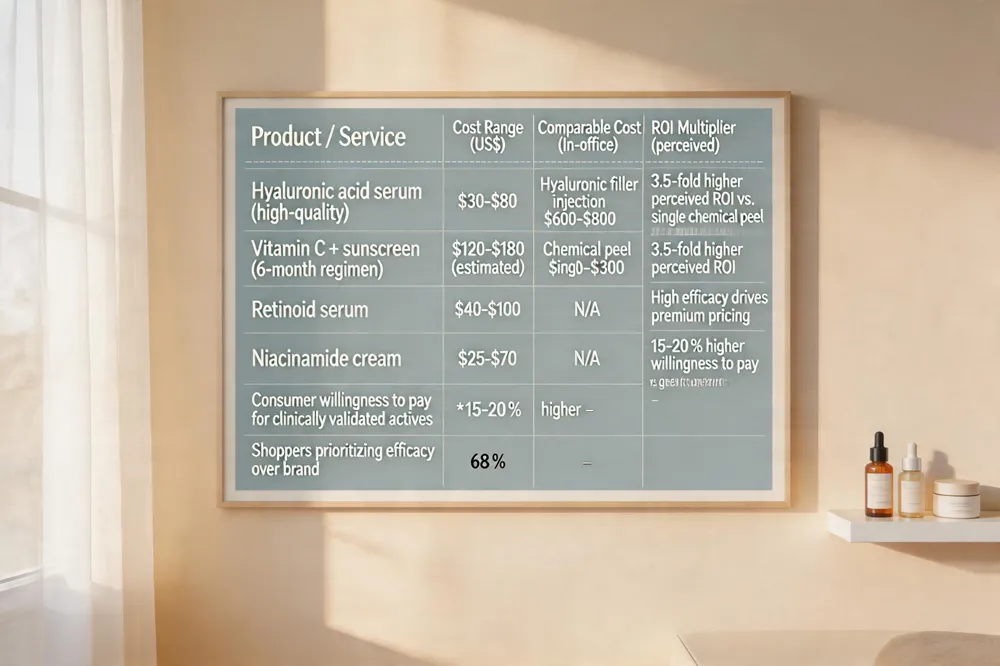
| Product / Service | Cost Range (US$) | Comparable Cost (In‑office) | ROI Multiplier (perceived) |
|---|---|---|---|
| Hyaluronic acid serum (high‑quality) | $30‑$80 | Hyaluronic filler injection $600‑$800 | 3.5‑fold higher perceived ROI vs. single chemical peel |
| Vitamin C + sunscreen (6‑month regimen) | $120‑$180 (estimated) | Chemical peel (single) $200‑$300 | 3.5‑fold higher perceived ROI |
| Retinoid serum | $40‑$100 | N/A | High efficacy drives premium pricing |
| Niacinamide cream | $25‑$70 | N/A | 15‑20 % higher willingness to pay vs. generic |
| Consumer willingness to pay for clinically validated actives | 15‑20 % higher | – | – |
| Shoppers prioritizing efficacy over brand | 68 % | – | – |
 Typical gross margins for private‑label lines are thus well above the 30 % benchmark used in spa services, allowing brands to absorb packaging and marketing costs while still delivering strong returns.
Cost ranges illustrate the value proposition: a high‑quality hyaluronic acid serum costs $30‑$80, whereas a single professional hyaluronic filler injection runs $600‑$800 per syringe. A cost‑effectiveness analysis showed that a six‑month regimen of topical vitamin C plus sunscreen yields a 3.5‑fold higher perceived ROI in skin appearance compared with a single in‑office chemical peel.
Consumer willingness to pay reflects this premium positioning—68 % of U.S. shoppers prioritize efficacy over brand name, and willingness to pay for clinically validated actives (retinoids, vitamin C, niacinamide) is 15‑20 % higher than for generic alternatives. This willingness underpins the robust margins and ROI observed across the skincare market.
Clinical Evidence Behind High‑Impact Ingredients
| Ingredient | Clinical Effect | % Improvement / Reduction | Cost (US$) |
|---|---|---|---|
| Broad‑spectrum sunscreen | Prevents new wrinkle formation | ≤ 24 % over 5 years (JAMA Dermatology, 2022) | $10‑$30 per bottle |
| Retinoids (vitamin A derivatives) | Improves skin texture & fine‑line depth | ≈ 15 % after 1 year (2021 RCT) | $30‑$80 per bottle |
| Vitamin C serum | Boosts collagen synthesis, reduces oxidative stress | – | $30‑$80 per bottle |
| Niacinamide (10 %) | Lowers hyperpigmentation | ≈ 15 % after 12 weeks (JCD, 2022) | $25‑$70 per bottle |
| Hyaluronic‑acid moisturizer | Hydration & short‑term plumping | Comparable to filler (non‑invasive) | $30‑$80 |
| Injectable hyaluronic filler | Immediate volumizing effect | – | $600‑$800 per syringe |
| LED light therapy + antioxidants | Increases collagen density | ≈ 22 % after 8 weeks (Photomedicine & Laser Surgery, 2023) | $150‑$300 per session |
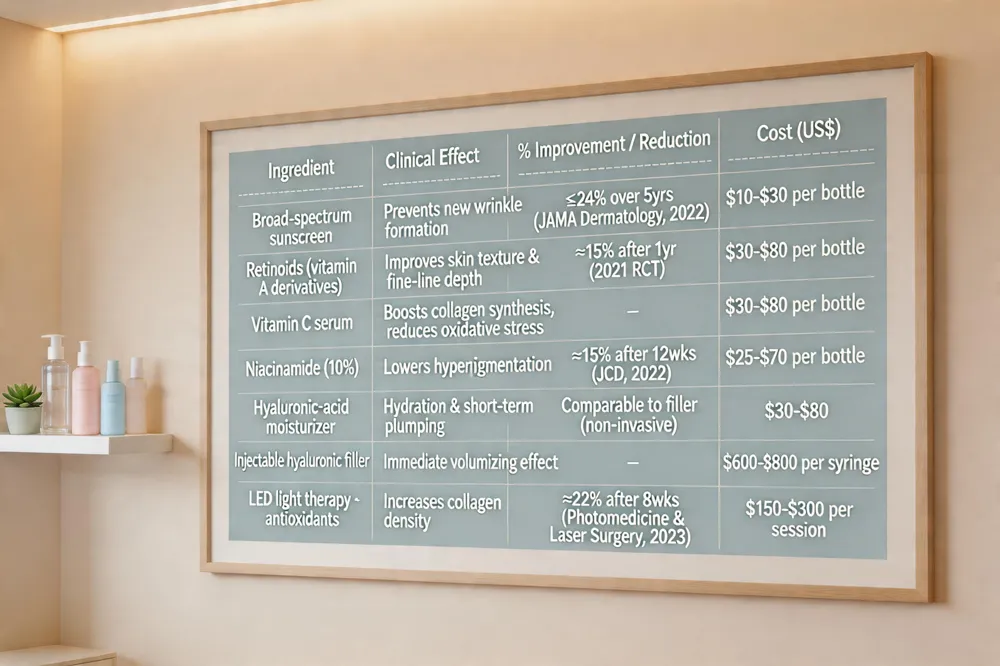 Broad‑spectrum sunscreen is a proven anti‑aging tool; daily use can cut new wrinkle formation by up to 24 % over five years (JAMA Dermatology, 2022)
Retinoids, the vitamin A derivatives, improve skin texture and fine‑line depth by an average of 15 % after a year of consistent application (2021 RCT)
Vitamin C serums boost collagen synthesis and reduce oxidative stress, while 10 % niacinamide lowers hyperpigmentation by ~15 % after 12 weeks (Journal of Cosmetic Dermatology, 2022)
Hyaluronic‑acid moisturizers ($30‑$80) provide hydration at a fraction of the cost of injectable fillers ($600‑$800 per syringe), delivering comparable short‑term plumping without invasive procedures
LED light therapy combined with topical antioxidants raises collagen density by 22 % after eight weeks, offering a non‑invasive ROI similar to mild laser resurfacing (Photomedicine and Laser Surgery, 2023)
Together, these evidence‑based ingredients form a cost‑effective regimen that enhances barrier function, reduces signs of aging, and minimizes the need for expensive procedural interventions.
Health Economics Careers and Practice ROI
| Role / Metric | Salary / ROI | Year / Period | Notes |
|---|---|---|---|
| Avg. U.S. health economist | $93,800 | – | National average |
| Senior health economist | $142,060 | – | – |
| Senior economist (San Jose, CA) | > $280,000 | – | High‑cost market |
| Entry‑level economist (Seattle, WA) | $141,873 | – | ~51 % above national avg |
| Dermatology practice digital marketing | 20‑30 % reduction in patient‑acquisition cost | – | Compared to traditional ads |
| Digital marketing ROI vs. single‑channel | 2.5× higher ROI | – | – |
| Aesthetic service profit margin (fillers, neuromodulators) | > 30 % benchmark | – | Sustainable profitability |
| Patient retention boost from personalized regimens | 15‑25 % | – | Increases LTV |
 Health economics offers lucrative career paths. The average U.S. health economist earns roughly $93,800 annually, while senior professionals can command $142,060. In high‑cost markets such as San Jose, CA, senior salaries exceed $280,000, and entry‑level roles in Seattle, WA start near $141,873—about 51 % above the national average.
A healthcare economist evaluates how medical resources are produced, allocated, and financed. By applying cost‑benefit analyses, decision‑modeling, and impact assessments, they guide hospitals, insurers, and policymakers toward efficient, equitable care and help design cost‑effective interventions.
Dermatology practices that invest in targeted digital marketing see a 20‑30 % reduction in patient‑acquisition costs and a 2.5× higher ROI versus single‑channel campaigns. Profit margins in aesthetic services are strong: hyaluronic acid fillers ($600‑$800 per syringe) and neuromodulators deliver high‑margin revenue, often exceeding the 30 % benchmark for sustainable profitability.
Personalized skincare regimens boost patient retention by 15‑25 %, translating into higher lifetime value (LTV) and steady product sales. Integrating evidence‑based, dermatologist‑prescribed products—such as retinoids, vitamin C, and niacinamide—ensures measurable skin‑health outcomes while supporting the practice’s financial health.
Consumer Insights, Transparency & Brand History
| Insight | Statistic | Source / Note |
|---|---|---|
| Importance of ingredient transparency | 68 % of shoppers say clear labeling is essential | – |
| Willingness to pay more for disclosed actives | 15‑20 % premium | – |
| "1 % rule" for hero actives | Ingredients before the 1 % line ≥ 1 % concentration | – |
| Historical brand entry – Avon | 1886 (California Perfume Company) | – |
| Historical brand entry – Mary Kay | 1963 | – |
| DNA‑guided serum market projection | $10.9 billion by 2035 | – |
| Consumer willingness for DNA‑personalized unit | $80‑$180 per unit | – |
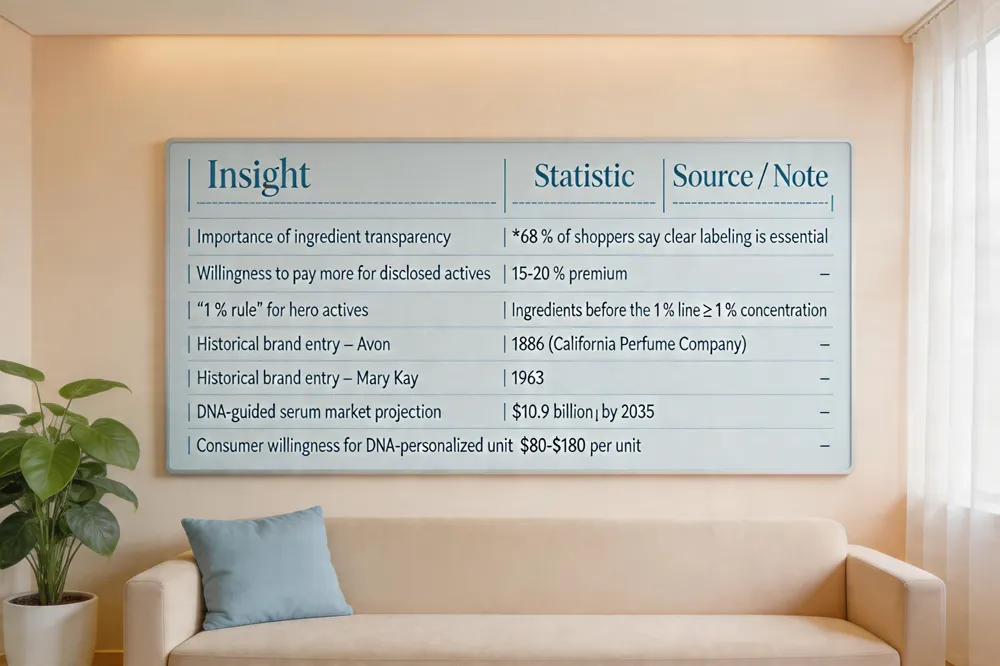 Ingredient transparency is now a decisive purchase factor: 68 % of shoppers say clear labeling is essential, and they are willing to pay 15‑20 % more for products that disclose active concentrations. The industry’s “1 % rule” helps shoppers spot the hero actives—ingredients listed before the 1 % line are present at ≥ 1 % and are likely to deliver therapeutic benefit, while those after the line are supporting components.
Historically, Avon entered the market in 1886 (originally the California Perfume Company), predating Mary Kay, which was founded in 1963.
Future Outlook & Action Steps
The global skincare market is projected to exceed $210 billion by 2028, driven by digital sales channels that now account for nearly one‑third of purchases. Clinics that prioritize evidence‑based, high‑margin products—such as medical‑grade serums with stable vitamin C, niacinamide, or retinoids—can offset costly procedures and improve patient satisfaction. Health‑economics analyses show that preventive regimens reduce long‑term treatment costs and increase practice profitability, with a 1.5‑fold ROI for three‑product routines. Personalized regimens, guided by DNA or microbiome testing, boost adherence by 17 % and generate higher lifetime value, making them a cornerstone of sustainable growth. Investing in continuous staff education on product science further enhances recommendation accuracy and customer loyalty.