Why Seasonal Swaps Matter
Seasonal shifts dramatically alter the skin's environment. In winter, low humidity and indoor heating strip lipids, increasing transepidermal water loss, while summer heat and UV intensity boost sebum production and free‑radical formation. Dermatology societies such as the American Academy of Dermatology recommend reassessing routines every three months to align products with these changes. A moisturizer that is too heavy in summer can clog pores, whereas a light gel may leave winter skin barrier‑compromised. Likewise, sunscreen must be broad‑spectrum and SPF 30+ year‑round, with higher SPF or more frequent reapplication during peak UV months. Ingredients like ceramides, hyaluronic acid, and niacinamide provide barrier support and hydration across climates, while antioxidant serums (vitamin C, E) protect against season‑specific oxidative stress. By swapping formulations in sync with temperature, humidity, and UV fluctuations, patients preserve efficacy, reduce irritation, and maintain optimal skin health throughout the year.
Core Rules for Product Timing and Application
Core Rules for Product Timing and Application
| Rule | Description | Benefit |
|---|---|---|
| 1 % Rule | FDA requires ingredients ≥1 % to be listed in descending order on the INCI. | Lets you spot key actives (e.g., niacinamide, hyaluronic acid) quickly. |
| 3‑Second Rule | Apply moisturizer or post‑cleanse treatment within 3 seconds of patting the face dry. | Locks in moisture while skin is still damp for deeper penetration. |
| 3‑Minute Moisturizer Rule | Apply moisturizer within 3 minutes of showering or washing. | Reduces transepidermal water loss (TEWL) and seals in hydration. |
| Korean 4‑2‑4 Rule | 4 min oil‑based cleanse → 2 min water‑based foam → 4 min rinsing (lukewarm → cool). | Thoroughly removes makeup, sunscreen, and excess sebum without harming the barrier. |
| Timing Consistency | Follow the above timing guidelines daily. | Supports a healthy barrier, better active absorption, and long‑term skin resilience. |
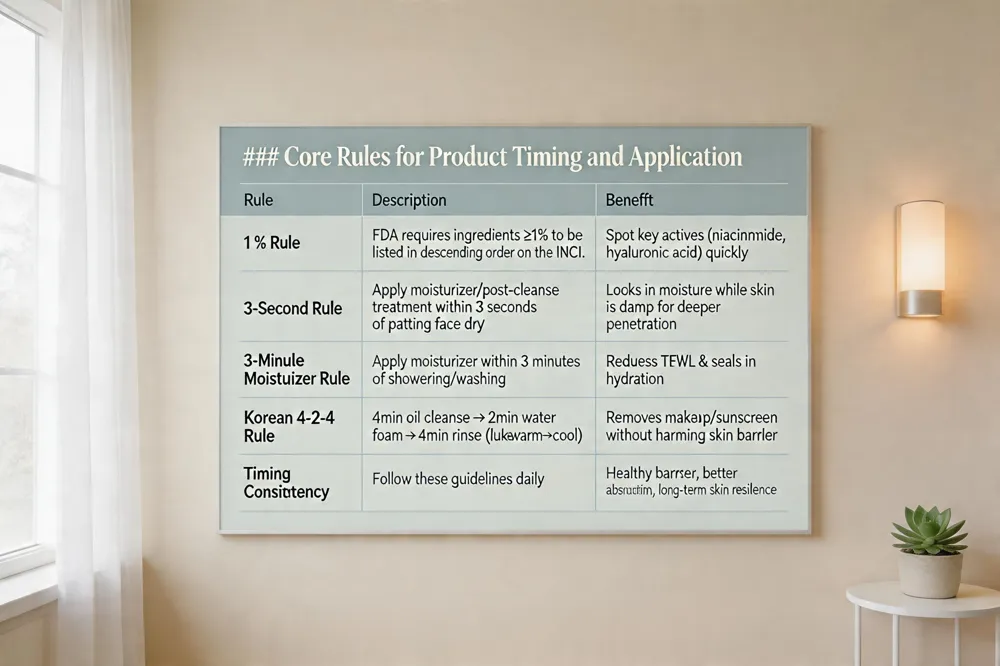 Understanding how and when you apply skincare maximizes its benefits. The 1 % rule, set by the FDA, requires ingredients present at 1 % or higher to be listed in descending order, letting you spot key actives such as niacinamide or hyaluronic acid. The 3‑second rule advises applying moisturizer or post‑cleanse treatment within three seconds of patting the face dry, sealing in moisture while the skin is still slightly damp for deeper penetration. The 3‑minute moisturizer rule extends this principle to bathing: apply a moisturizer within three minutes of showering or washing to lock in water and reduce transepidermal water loss. Finally, the Korean 4‑2‑4 rule structures double cleansing: 4 minutes of oil‑based cleansing, 2 minutes of water‑based foam, and 4 minutes of rinsing (lukewarm then cool) to remove makeup, sunscreen and excess sebum without compromising the barrier. Following these timing guidelines supports a healthy barrier, better absorption of actives, and overall skin resilience year‑round, and optimal cosmetic results for long‑term skin health.
Seasonal Moisturizer & Sunscreen Strategies
Seasonal Moisturizer & Sunscreen Strategies
| Season | Moisturizer Type | Key Ingredients / Features | SPF Recommendation |
|---|---|---|---|
| Winter | Rich, occlusive cream | Ceramides, hyaluronic acid, shea butter | Broad‑spectrum SPF 30+ (apply every morning, reapply after sweating) |
| Summer | Lightweight, oil‑free gel‑cream | Humectants (hyaluronic acid, glycerin), antioxidant serums | Broad‑spectrum SPF 30+ (reapply every 2 hrs outdoors) |
| All Seasons (K‑style) | SPF moisturizer (gel‑cream) | Hyaluronic acid, niacinamide, SPF 45‑50 | Same as above; choose Korean SPF moisturizers (e.g., Round Lab Birch SPF 45+) |
| Winter Add‑ons | Humidifier, mild lactic‑acid exfoliant 1‑2×/wk | — | — |
| Summer Add‑ons | None needed beyond lightweight texture | — | — |
| Routine Example (Winter) | Cleanser → Rich barrier‑repair moisturizer (on damp skin) → SPF 30+ | Ceramide cleanser, barrier‑repair cream | — |
| Routine Example (Summer) | Cleanser → Light gel‑cream moisturizer (on damp skin) → SPF 30+ | Glycerin, hyaluronic acid | — |
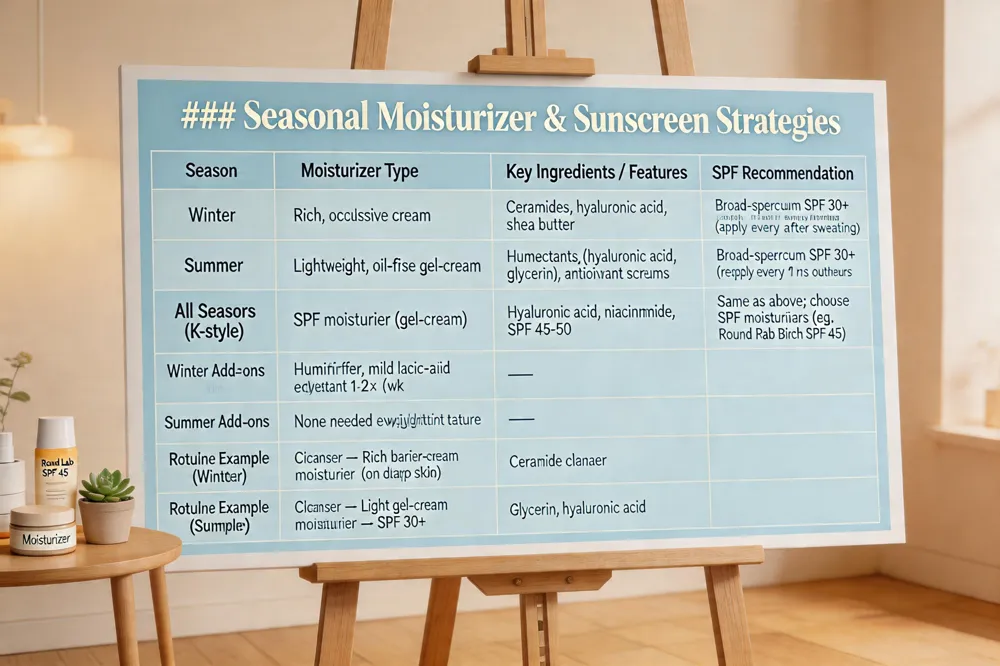 Winter barrier repair restores lost lipids caused by low humidity and indoor heating. Use a gentle, ceramide‑rich cleanser, then apply a rich, occlusive moisturizer while skin is still damp to lock in moisture and reduce transepidermal water loss. Broad‑spectrum SPF 30+ should be applied each morning, even on cloudy days, and reapplied after sweating.
Summer calls for lightweight, oil‑free moisturizers with humectants such as hyaluronic acid or glycerin, which hydrate without a greasy feel. Gel‑cream or water‑based formulas let sunscreen sit on top and prevent clogged pores.
Korean SPF moisturizers blend sun protection with hydration. Top picks: Round Lab Birch Moisturizing Sunscreen UVLock SPF 45+, Missha Super Aqua UV Defense Sun Cream SPF 50+, Etude House SoonJung Mild Defense SPF 50+, and Innisfree Daily UV Defense SPF 36+. These are widely available in U.S. stores.
Best Korean moisturizer with SPF: Round Lab Birch SPF 45+ (gel‑cream, hyaluronic acid, niacinamide). Best winter routine: gentle ceramide cleanser → rich barrier‑repair moisturizer → SPF 30+ sunscreen; add a humidifier, avoid hot showers, and use a mild lactic‑acid exfoliant 1‑2× weekly.
Targeted Eye Care Across Seasons
Targeted Eye Care Across Seasons
| Season | Eye Cream Type | Key Ingredients | Primary Benefits |
|---|---|---|---|
| Winter | Rich cream | Hyaluronic acid, glycerin, ceramides, shea butter | Locks in moisture, reduces fine‑line depth |
| Spring | Antioxidant‑rich cream | Vitamin C, niacinamide, light sunscreen | Brightens dark circles, protects against UV damage |
| Summer | Lightweight gel | Caffeine, peptides, green‑tea polyphenols | Reduces puffiness, swelling, and oiliness |
| Autumn | Peptide‑filled richer cream | Peptides, ceramides, niacinamide | Supports collagen synthesis after summer sun stress |
| All‑Year Favorites | Fragrance‑free, non‑comedogenic | Hyaluronic acid, ceramides, peptides/retinol/antioxidants | Consistent hydration & anti‑aging effects |
| Top Picks | — | — | Neutrogena Rapid Wrinkle Repair Eye Cream, CeraVe Eye Repair Cream, La Roche‑Posay Toleriane Ultra Eye Cream, SkinCeuticals A.G.E. Advanced Eye, Tatcha The Brightening Eye Cream, Ordinary Caffeine Solution 5% + EGCG, First Aid Beauty Eye Duty Niacinamide Brightening Cream |
| Application Tip | — | — | Pat gently with ring finger to enhance absorption |
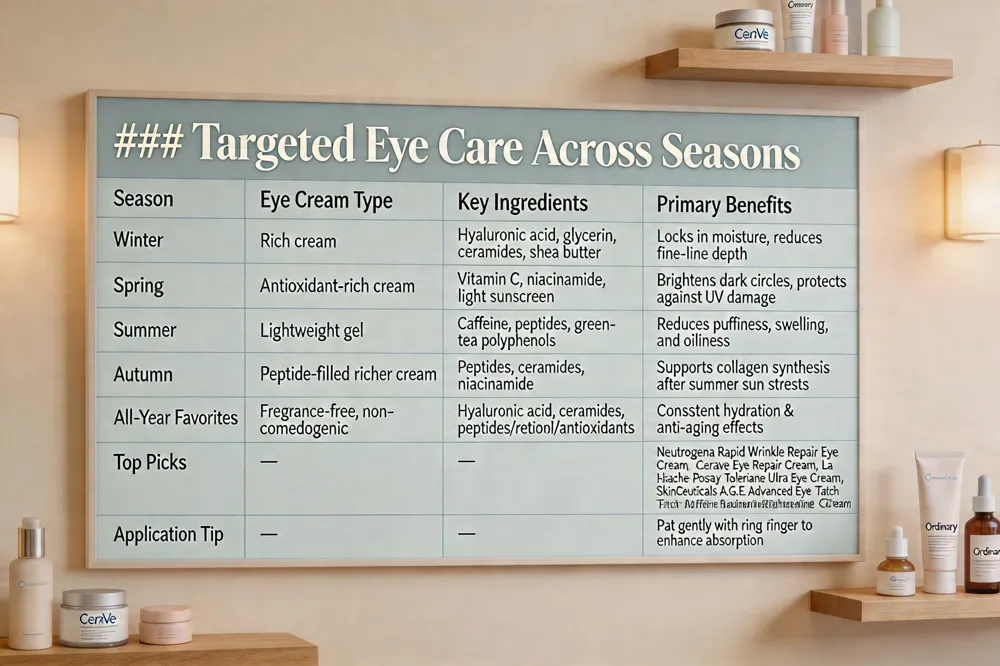 The delicate skin around the eyes reacts quickly to seasonal changes, so a season‑specific routine is essential. In winter, low humidity compromises the barrier; choose a cream that blends humectants (hyaluronic acid, glycerin) with occlusives (ceramides, shea butter to lock in moisture and prevent fine‑line depth. Spring brings higher pollen counts and UV exposure; antioxidant‑rich formulas with vitamin C, niacinamide, and a light sunscreen layer help brighten dark circles and protect against photo‑damage. Summer heat and humidity increase oil production and puffiness; lightweight gel‑based eye creams with caffeine, peptides, and green‑tea polyphenols reduce swelling without feeling heavy. Autumn is ideal for transitioning to richer, peptide-filled moisturizers that support collagen synthesis after summer sun stress. Dermatologists typically recommend fragrance‑free, non‑comedogenic eye creams that combine hydrating agents (hyaluronic acid, ceramides with anti‑aging ingredients such as peptides, retinol, or antioxidants. Popular dermatologist‑favored options include Neutrogena Rapid Wrinkle Repair Eye Cream, CeraVe Eye Repair Cream, and La Roche‑Posay Toleriane Ultra Eye Cream. For under‑eye moisturizers, top picks are SkinCeuticals A.G.E. Advanced Eye (peptide‑rich, caffeine‑infused), Tatcha The Brightening Eye Cream (vitamin C, niacinamide), The Ordinary Caffeine Solution 5% + EGCG (budget‑friendly de‑puffing), and First Aid Beauty Eye Duty Niacinamide Brightening Cream (daily hydration). Apply with a gentle patting motion to enhance absorption and maintain a smooth, refreshed eye area year‑round.
Evaluating Product Value & Switching Frequency
Evaluating Product Value & Switching Frequency
| Factor | Details | Example |
|---|---|---|
| Cost vs. Efficacy | Price is not a reliable proxy for performance. Drugstore brands often deliver clinically proven actives at lower prices. | CeraVe, La Roche‑Posay, The Ordinary vs. luxury brands |
| INCI Check | Verify ingredient concentration (≥1 % for actives) before assuming superiority. | Look for niacinamide ≥ 5 % or hyaluronic acid ≥ 1 % |
| Core Trio Stability | Keep cleanser, moisturizer, and SPF stable; rotate actives every 8‑12 weeks. | Allows skin turnover and proper evaluation |
| Seasonal Adjustment | Switch to richer, ceramide‑rich moisturizers in winter; lighter, humectant‑rich formulas in spring/summer. | Winter → Ceramide cream; Summer → Glycerin gel‑cream |
| Product Swaps per Season | Limit to 1‑2 new items to clearly identify effects. | Add a vitamin C serum in spring, keep other products unchanged |
| Dermatologist Guidance | Follow recommendations for patch‑testing and gradual integration. | 48‑72 hr patch test before full‑face use |
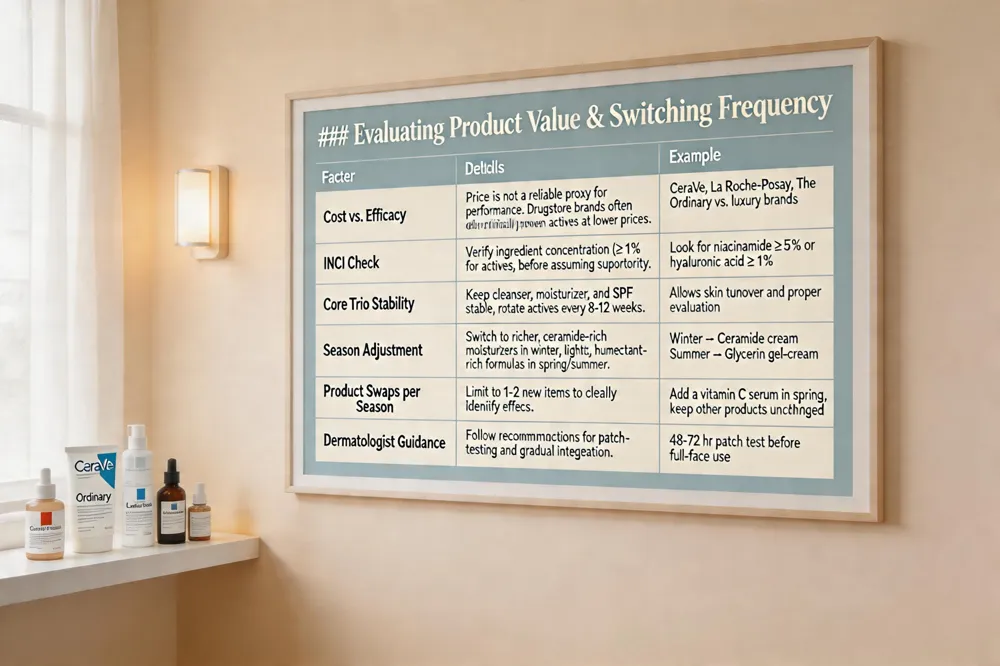 Cost vs efficacy: Price is not a reliable proxy for performance. Many drugstore brands (CeraVe, La Roche‑Posay, The Ordinary) deliver clinically proven actives—retinol, vitamin C, niacinamide, ceramides—at a fraction of luxury prices. A high‑ticket item may contain a novel ingredient at therapeutic levels, but such cases are rare; always check the INCI list and concentration before assuming superiority.
When to change products: Dermatologists advise keeping a core trio (cleanser, moisturizer, broad‑spectrum SPF stable and rotating actives every 8‑12 weeks. This aligns with the skin’s turnover cycle and allows enough time to evaluate results while minimizing irritation. Seasonal adjustment schedule: In winter, switch to richer, ceramide‑rich moisturizers and occlusives to counter low humidity‑related transepidermal water loss. In spring/summer, move to lightweight, oil‑free formulas with humectants (hyaluronic acid, glycerin) and antioxidant serums (vitamin C, niacinamide to address increased sebum and UV exposure. Reassess each season, but avoid swapping more than one or two products at once to clearly identify what works.
Seasonal Ingredient Spotlight: Antioxidants, Humectants, and Occlusives
Seasonal Ingredient Spotlight
| Ingredient | Category | Primary Benefit | Typical Use |
|---|---|---|---|
| Vitamin C | Antioxidant | Neutralizes UV‑generated free radicals, brightens, supports collagen | Spring & Summer serums (morning) |
| Niacinamide | Antioxidant / Barrier | Regulates sebum, reduces inflammation, reinforces barrier | Year‑round (day/night) |
| Hyaluronic Acid | Humectant | Attracts up to 1,000 × its weight in water, plumps skin | All seasons; applied to damp skin |
| Glycerin | Humectant | Hydrates without greasiness, ideal for summer gel‑creams | Summer moisturizers |
| Ceramides | Occlusive | Rebuilds lipid matrix, prevents TEWL, barrier repair | Winter creams and night moisturizers |
| Shea Butter | Occlusive | Forms protective film, locks in moisture | Winter night creams |
| Green‑Tea Polyphenols | Antioxidant | Reduces puffiness, anti‑inflammatory | Summer eye gels |
| Peptides | Anti‑Aging | Stimulate collagen synthesis, improve firmness | Autumn richer creams |
| Ferulic Acid | Antioxidant | Stabilizes vitamin C/E, boosts photoprotection | Daytime antioxidant serums |
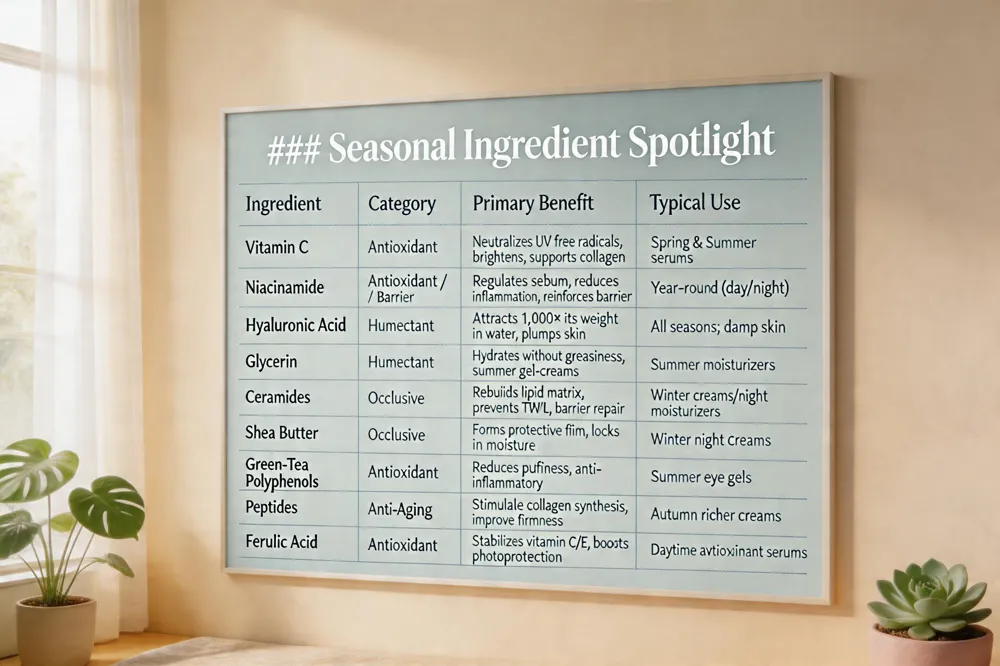 Vitamin C serums are a cornerstone of spring and summer routines because they neutralize UV‑generated free radicals, brighten dullness, and support collagen synthesis. Pairing vitamin C with a broad‑spectrum SPF maximizes protection against photoaging. Niacinamide, a stable vitamin B3, works year‑round to regulate sebum, reduce inflammation, and reinforce the skin barrier—especially useful when humidity shifts in spring or oil control is needed in summer. Hyaluronic acid, a powerful humectant that can hold up to 1,000 times its weight in water, delivers immediate plumping in humid months and serves as a moisture‑binding base for richer winter moisturizers. Ceramides act as occlusive lipids that rebuild the lipid matrix lost to low‑humidity winter air, preventing transepidermal water loss and supporting barrier repair. Combining antioxidant serums (vitamin C, vitamin E, ferulic acid) with hyaluronic acid and ceramide‑rich moisturizers creates a synergistic system: antioxidants combat oxidative stress, humectants attract water, and occlusives lock moisture in, keeping skin resilient across every season.
Practical Tips for Year‑Round Skin Health
Practical Tips for Year‑Round Skin Health
| Tip | Season / Condition | How to Implement |
|---|---|---|
| Humidifier Use | Dry winter indoor air | Run humidifier to keep indoor humidity >30 % |
| Glove Protection | Cold, windy winter | Wear gloves outdoors to prevent hand eczema |
| Exfoliation Frequency | Winter | Limit AHAs/BHAs to 1‑2 × /week |
| Exfoliation Frequency** | Summer | |
| Patch‑Testing | New product | Apply small amount on inner forearm for 48‑72 hrs, monitor for reactions |
| Hot Shower Limitation | All seasons | Keep showers lukewarm; avoid prolonged hot water to protect barrier |
| Water Intake | All seasons | Drink adequate water (≈2 L/day) to support skin hydration |
| Broad‑Spectrum SPF | Daily | Apply SPF 30+ every morning, reapply every 2 hrs outdoors |
| Gentle pH‑Balanced Cleanser | All seasons | Use a cleanser with pH ≈ 5.5 to maintain barrier health |
| Lifestyle Support | All seasons | Adequate sleep, balanced diet, stress management |
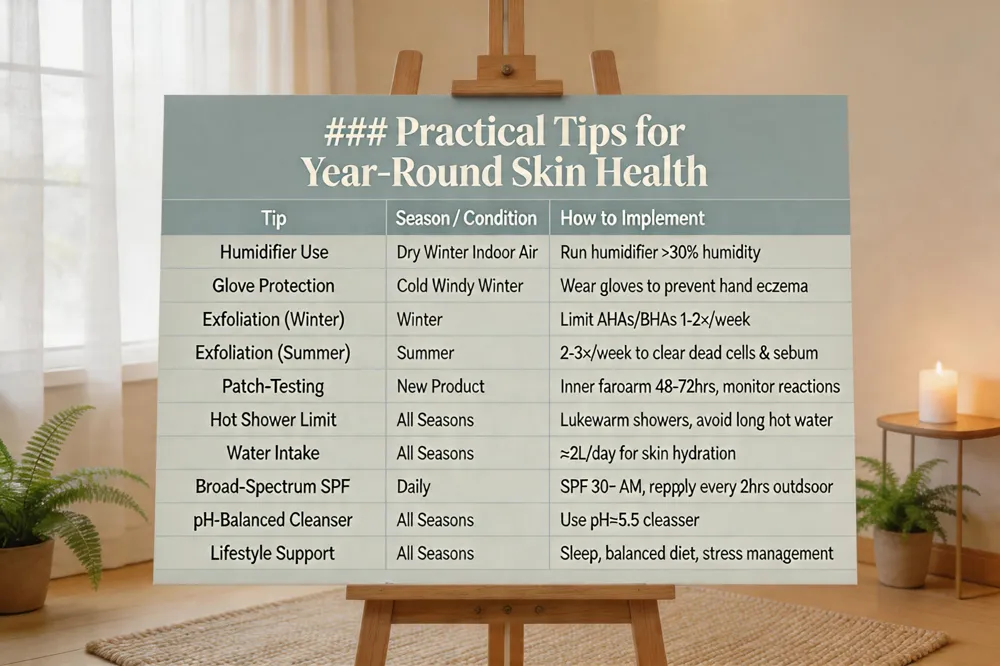 Maintaining a resilient skin barrier all year starts with environmental control. In dry winter months, run a humidifier at home to keep indoor humidity above 30 % and reduce transepidermal water loss; pair this with a ceramide‑rich moisturizer applied to damp skin for optimal lock‑in. Protect hands from cold, low‑humidity air by Gloves —especially when outdoors—to prevent eczema flares, cracked cuticles and brittle nails. Adjust exfoliation frequency to the season: limit AHAs/BHAs to 1‑2 times per week in winter to avoid barrier irritation, and increase to 2‑3 times per week in summer when excess dead cells and sebum accumulate. Before adding any new product, follow the American Academy of Dermatology’s patch‑testing protocol: apply a small amount to the inner forearm for 48‑72 hours and monitor for redness, itching, or swelling. Finally, adopt supportive lifestyle habits—drink adequate water, limit hot showers, use a gentle, pH‑balanced cleanser, and wear broad‑spectrum SPF 30+ daily, reapplying every two hours outdoors—to reinforce skin health regardless of the season.
Putting It All Together
Seasonal product rotation is essential because temperature, humidity and UV intensity shift every three months, altering barrier needs and oil balance. In winter, swap light gels for ceramide‑rich, occlusive creams; in spring and summer replace them with hyaluronic‑acid‑based, oil‑free moisturizers and antioxidant vitamin C serums; in fall re‑introduce richer night creams with peptides to repair summer sun damage. Core application rules remain constant: cleanse gently, apply actives (vitamin C, niacinamide, retinoids) on clean skin, then seal with a humectant‑plus‑occlusive moisturizer while the skin is still damp, and finish with broad‑spectrum SPF 30+ every morning—even on cloudy days. Re‑apply sunscreen every two hours outdoors. These disciplined steps protect the barrier, reduce transepidermal water loss, and prevent photo‑aging, supporting long‑term skin health and a resilient, youthful complexion.