Introduction
Peptides are short chains of amino acids that act as signaling messengers in the skin, directing fibroblasts to produce collagen, elastin, and other extracellular‑matrix proteins. Their therapeutic potential depends on reaching viable epidermal layers, yet the stratum corneum blocks most molecules larger than 500 Da and highly hydrophilic peptides. Strategies such as lipidation (e.g., palmitoyl groups), positive‑charge residues, nanocarriers (liposomes, ethosomes), and physical methods (microneedling, iontophoresis) improve penetration, allowing peptides like Matrixyl®, GHK‑Cu, and Argireline to stimulate repair, reduce inflammation, and provide mild neuromodulatory effects. For dermatology patients, effective delivery translates into measurable improvements in firmness, wrinkle depth, and wound healing, making peptide‑based regimens a valuable adjunct to conventional anti‑aging and therapeutic protocols.
The Science of Peptide Penetration
Peptide Penetration Overview
| Peptide Type | Typical Length (aa) | Net Charge | Primary Mechanism | Comments |
|---|---|---|---|---|
| Skin‑penetrating peptides (SKPs) | 6‑30 | Variable (often neutral) | Traverse stratum corneum without disruption | e.g., TD‑1, SPACE, SPEH act as permeation enhancers |
| Cell‑penetrating peptides (CPPs) | 6‑30 | Positive (arginine‑rich) | Interact with lipid lamellae, transient pore formation | TAT, penetratin, 589WP show highest trans‑mal flux |
| Positively‑charged short peptides (lysine‑terminal) | 5‑15 | +1 to +2 | Electrostatic attraction to negatively‑charged lipid matrix | Improves permeability vs neutral/negative peptides |
| Nanocarrier‑associated peptides | Variable | Depends on carrier | Lipid‑fusion or endocytosis via vesicles (liposomes, ethosomes) | Enhances stability and dermal bioavailability |
| Physical‑method‑assisted delivery | Variable | N/A | Micro‑channels (microneedling), iontophoresis, laser ablation | Allows larger peptides (e.g., Palmitoyl‑Pentapeptide‑4) to reach viable epidermis |
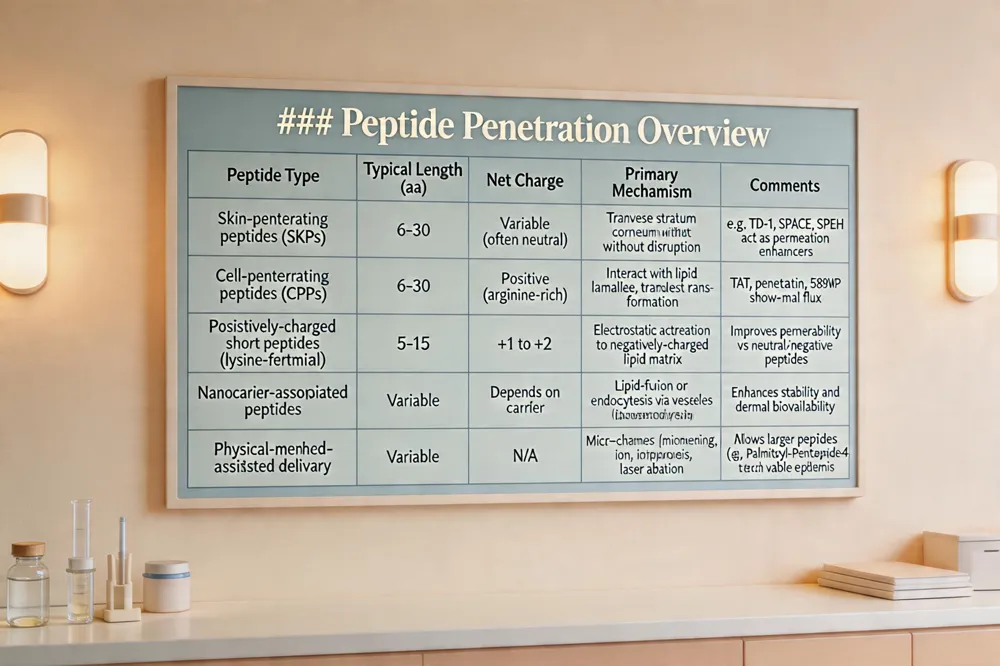 Peptides are too large and hydrophilic to cross the stratum corneum by passive diffusion. Molecules with a molecular weight below 500 Da, a log P (octanol/water) between 1 and 3, and limited hydrogen‑bond donors/acceptors have the highest chance of passive skin penetration. Positively charged peptides (e.g., those containing lysine at the termini) bind more readily to the negatively charged lipid matrix of the skin, improving their permeabilityation compared with neutral or negatively charged peptides. Skin‑penetrating peptides (SKPs) are short peptides (6–30 amino acids) that traverse the stratum corneum without disrupting skin layers such as TD‑1, SPACE, and SPEH act as permeation enhancers, allowing macromolecules like insulin or siRNA to traverse the barrier without disrupting skin layers. Cell‑penetrating peptides (CPPs) – arginine‑rich motifs like TAT, penetratin, and the optimized 589WP variant – can translocate across both cellular membranes and the stratum corneum by interacting with lipid lamellae and creating transient pores. Among CPPs, penetratin and its analog 589WP show the highest transdermal flux and low irritation, making them the best‑performing skin‑penetrating carriers for cosmetic and therapeutic agents. Delivery strategies that combine low‑molecular‑weight, positively charged peptides with nanocarriers (liposomes, ethosomes, solid‑lipid nanoparticles) or physical methods (microneedling, iontophoresis, laser ablation) dramatically improve peptide stability and dermal bioavailability, enabling clinically relevant collagen‑stimulating and anti‑inflammatory effects.
Delivery Platforms, Enhancers, and Economic Considerations
Delivery Enhancers & Platforms
| Enhancer / Platform | Mechanism | Typical Peptide(s) Delivered | Irritation / Safety Notes |
|---|---|---|---|
| Oleic acid, propylene glycol, ethanol, DMSO, terpenes, surfactants | Disrupt lipid lamellae → increase flux | Many CPPs & SKPs | High concentrations may cause irritation |
| Microneedling | Creates micro‑channels → bypass stratum corneum | Palmitoyl‑Pentapeptide‑4, GHK‑Cu, larger polymers | Minimal pain, low risk if sterile |
| Iontophoresis | Electrical current drives charged peptides | Positively charged CPPs (e.g., 589WP) | Generally safe; monitor for skin erythema |
| Fractional laser ablation | Vaporizes stratum corneum spots → transient pores | All skin‑penetrating peptides | Requires trained operator; possible erythema |
| Liposomes / Ethosomes | Ethanol‑rich vesicles fuse with skin lipids | Palmitoyl‑Pentapeptide‑4, GHK‑Cu | Good stability, low irritation |
| Niosomes, SLNs, NLCs | Solid lipid carriers protect from proteolysis | Copper‑tri‑peptide‑1, GHK‑Cu | Enhanced dermal uptake, minimal irritation |
| Pricing (CPPs) | Custom synthesis (10‑15 aa) | $50‑$200 per mg (research) ; Bulk $5‑$20 per g ; High‑purity (>95%) $200‑$500 per g | Dermatology budget ≈ $0.10‑$0.30 per mg |
| n |
 Chemically, skin‑penetration enhancers such as oleic acid, propylene glycol, ethanol, dimethylsulfoxide, terpenes and surfactants disrupt the lipid lamellae of the stratum corneum, increasing peptide flux but may cause irritation at high concentrations. Physical methods—microneedling, iontophoresis, and fractional laser ablation—create temporary micro‑channels or transient pores, allowing larger peptides (e.g., Palmitoyl‑Pentapeptide‑4, GHK‑Cu) to reach the viable epidermis and dermis with minimal pain. Nanocarriers further protect peptides from proteolysis and improve their partitioning into skin lipids: liposomes and ethosomes (ethanol‑rich vesicles) have shown superior delivery of Palmitoyl‑Pentapeptide‑4, while niosomes, solid‑lipid nanoparticles (SLNs) and nanostructured lipid carriers enhance the stability and dermal uptake of copper‑tri‑peptide‑1.
Skin penetrating peptides cost: The price of skin‑penetratin peptides depends mainly on their length, purity level and any special modifications such as fluorescent tags or drug‑conjugation linkers. Typical custom synthesis of a short (10‑15 amino‑acid) CPP for research purposes ranges from roughly $50 to $200 per milligram, while bulk‑order batches of several grams can drop to $5 – $20 per gram. Peptides that are highly purified (≥95 % purity) or contain non‑standard residues often cost $200 – $500 per gram. Because the market for cell‑penetrating peptides is expanding rapidly—projected to exceed $8 billion by 2033—many suppliers now offer tiered pricing that makes small‑scale cosmetic formulations more affordable than earlier estimates. For a dermatologist looking to incorporate a skin‑penetrating peptide into a topical product, a realistic budget would be $0.10 – $0.30 per milligram of peptide, translating to a few hundred dollars for a typical batch used in clinical practice.
Top Peptide Candidates and Their Skin Benefits
Key Peptide Candidates
| Peptide | Class | Primary Skin Benefit(s) | Typical Formulation |
|---|---|---|---|
| Palmitoyl‑Pentapeptide‑4 (Matrixyl) | Signal peptide | Stimulates collagen I/III, elastin synthesis | Liposome/ethosome serum |
| Palmitoyl‑Tetrapeptide‑7 | Signal peptide | Reduces inflammation, MMP activity | Cream or serum |
| GHK‑Cu (Copper Tripeptide‑1) | Carrier peptide | Antioxidant, wound healing, collagen boost | Liposome, solid‑lipid nanoparticle |
| Acetyl Hexapeptide‑8 (Argireline) | Neurotransmitter‑inhibitor | Mild Botox‑like muscle relaxation | Topical cream/serum |
| Snap‑8 (Acetyl Octapeptide‑3) | Neurotransmitter‑inhibitor | Improves wrinkle depth, similar to Argireline | Serum |
| Tripeptide‑1 | Carrier peptide | Delivers copper ions, antioxidant protection | Moisturizer |
| Pea‑derived lysine‑rich peptides | Natural peptide | Gentle penetration, collagen stimulation | Natural‑based serum |
| Biotinoyl‑Tripeptide‑1 (hair) | Hair‑focused | Stimulates follicular stem cells, density | Scalp serum |
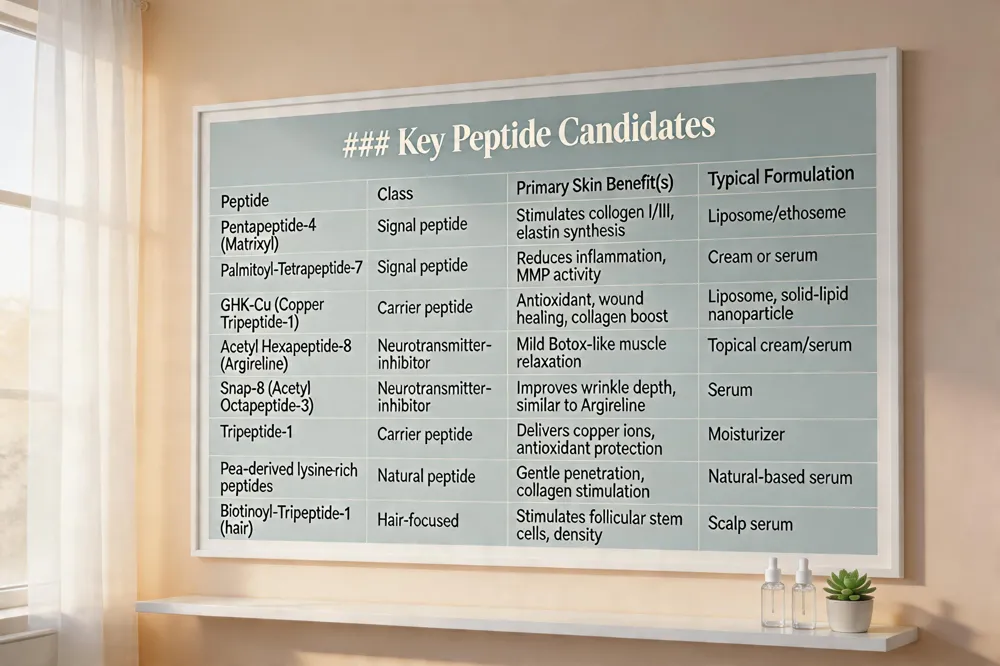 Signal peptides – e.g., Palmitoyl Pentapeptide‑4 (Matrixyl) and Palmitoyl Tetrapeptide‑7 – bind fibroblast receptors, boosting collagen I/III and elastin synthesis for firmer, smoother skin.
Carrier peptides – Copper Tripeptide‑1 (GHK‑Cu) and Manganese Tripeptide‑1 transport essential minerals into the dermis, supporting antioxidant defenses, wound healing, and matrix remodeling.
Enzyme‑inhibitor peptides – Soy‑, silk‑, rice‑derived fragments, and synthetic Trifluoroacetyl Tripeptide‑2 inhibit matrix‑metalloproteinases, preserving existing collagen and reducing wrinkle depth.
Neurotransmitter‑inhibiting peptides – Acetyl Hexapeptide‑8 (Argireline) and Snap‑8 (Acetyl Octapeptide‑3) temper facial‑muscle contraction, offering a mild Botox‑like smoothing of expression lines.
Natural and plant‑derived peptides – Pea‑derived lysine‑rich peptides and other botanical sequences are low‑molecular‑weight, gently penetrate the stratum corneum, and stimulate renewal without irritation.
Best peptide skincare benefits – Peptides signal collagen/elastin production, deliver minerals, inhibit degradative enzymes, and calm inflammation, improving elasticity, hydration, and radiance.
Peptide skincare benefits for face – Enhanced firmness, reduced fine lines, smoother texture, and increased hyaluronic‑acid production when delivered via liposomes, ethosomes, or microneedle‑pretreated formulations.
Best peptides for skin – Matrixyl, Acetyl Hexapeptide‑8 (Argireline), Copper Tripeptide‑1 (GHK‑Cu), Snap‑8, and Tripeptide‑1 are consistently supported by clinical data.
Best peptides for anti‑aging – Palmitoyl Pentapeptide‑4, Acetyl Hexapeptide‑8, and Copper Peptide‑1 are top choices, especially when combined with sun protection and hydration.
Natural peptides for skin – Plant‑derived sequences (e.g., pea peptides) offer gentle, effective anti‑aging action for sensitive skin.
Examples of peptides in skincare – Matrixyl, Acetyl Hexapeptide‑8 (Argireline), Copper Tripeptide‑1 (GHK‑Cu), Palmitoyl Tripeptide‑1, Acetyl Tetrapeptide‑5, and Tripeptide‑1 appear in serums, moisturizers, and eye creams, delivering measurable improvements in firmness and wrinkle depth after 8‑12 weeks of consistent use.
Oral Peptide Supplements and Nutrition
Oral Peptide Supplement Overview
| Supplement | Source | Typical Molecular Size | Bioavailability Factors | Common Dose |
|---|---|---|---|---|
| Collagen peptides | Hydrolyzed bovine, porcine, marine collagen | Mostly di‑/tri‑peptides (<500 Da) | Small size, positive/neutral charge improves uptake | 10‑20 g per day (≈5‑10 g peptides) |
| Copper‑GHK‑Cu | Synthetic tripeptide (GHK‑Cu) | ~500 Da, positively charged | Stable formulation needed; copper binding aids uptake | 1‑2 mg per day |
| Plant‑derived peptides (pea, rice) | Legume or grain hydrolysates | 2‑5 kDa (larger) | May be partially degraded; often combined with protease inhibitors | 5‑10 g per day |
| Bone broth / fish skin | Natural collagen source | Mixed peptide sizes | Variable; cooking method affects peptide size | 250‑500 ml broth daily |
 Peptide supplements are oral products that contain short chains of amino acids—most commonly collagen peptides and copper‑GHK‑Cu—intended to support skin structure, hydration, and elasticity. Collagen peptides, derived from hydrolyzed animal collagen, are broken down during digestion into absorbable di‑ and tripeptides that can be taken up by fibroblasts and stimulate new collagen synthesis. Copper‑GHK‑Cu supplements deliver the copper‑binding tripeptide (GHK‑Cu), which has demonstrated anti‑aging and wound‑healing effects when stable in the skin. Bioavailability depends on peptide size, charge, and formulation; smaller, positively charged peptides (< 500 Da) penetrate more efficiently, while larger sequences may be degraded by gastrointestinal proteases. Dietary sources rich in natural peptides include bone broth, fish skin, and legumes. When choosing a supplement, prioritize reputable brands, follow dosage guidelines, and discuss use with a dermatologist, especially for pregnant individuals or those with medical conditions.
Injectable Peptide Therapies in Clinical Practice
Injectable Peptide Protocols
| Peptide | Route | Typical Volume per Zone | Frequency | Primary Clinical Effect |
|---|---|---|---|---|
| GHK‑Cu (Copper peptide) | Intradermal micro‑injection | 0.1‑0.3 mL | Every 4‑6 weeks | Collagen & elastin synthesis, wound healing |
| Palmitoyl‑Pentapeptide‑4 (Matrixyl) | Subcutaneous or intradermal | 0.1‑0.5 mL | Every 4‑6 weeks | Skin tightening, wrinkle reduction |
| Acetyl Hexapeptide‑8 (Argireline) | Intradermal | 0.05‑0.2 mL | Every 4‑6 weeks | Mild Botox‑like relaxation of facial muscles |
| Tripeptide‑1 (GHK‑Cu carrier) | Intradermal | 0.1‑0.3 mL | Every 4‑6 weeks | Antioxidant protection, matrix remodeling |
| Combination cocktail (GHK‑Cu + Matrixyl) | Intradermal | 0.2‑0.5 mL | Every 4‑6 weeks | Synergistic anti‑aging, improved firmness |
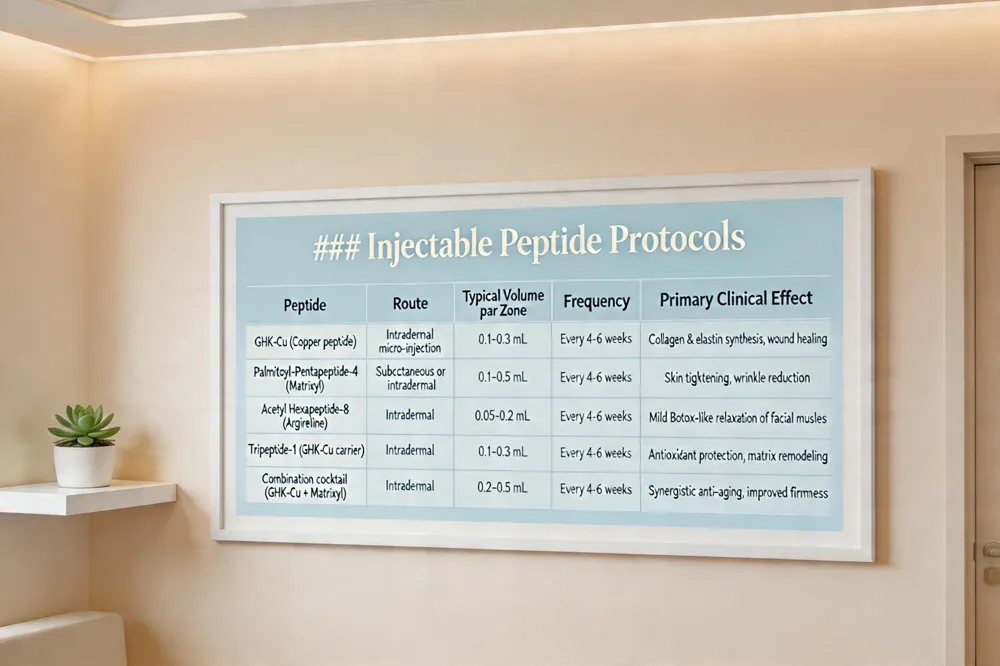 Injectable peptide treatments deliver short‑chain amino‑acid molecules directly into the dermis, where they act as signaling cues for fibroblasts, boosting collagen, elastin, and extracellular‑matrix synthesis. Subcutaneous or intradermal micro‑injections of copper peptide (GHK‑Cu) and signal peptides such as palmitoyl pentapeptide‑4 (Matrixyl®) have the strongest clinical evidence for skin‑tightening and anti‑aging. These peptides stimulate fibroblast proliferation, inhibit matrix‑metalloproteinases, and can modulate neuromuscular activity (e.g., Argireline for a mild Botox‑like effect. Typical protocols involve 0.1–0.5 mL per treatment zone, repeated every 4–6 weeks, with noticeable firmness and wrinkle reduction emerging after 4–6 weeks and continuing to improve over several months. Safety monitoring includes baseline skin assessment, patch testing for sensitivity, and post‑procedure observation for irritation or allergic reactions; most patients tolerate the injections well. For optimal results, combine peptide injections with supportive topical serums, sun protection, and adjunctive procedures such as microneedling or laser resurfacing, which create micro‑channels that further enhance peptide delivery. Individualized treatment plans, overseen by a board‑certified dermatologist, ensure efficacy while minimizing risk.
Practical Use, Safety, and Patient Guidance
Practical Use & Safety Guidelines
| Question | Recommendation |
|---|---|
| Frequency of topical peptide use | Twice‑daily (morning & night) after cleansing; start once‑daily for sensitive skin |
| Time for absorption | Penetration begins within minutes; most reach epidermis/dermis in 30‑60 min |
| Onset of visible results | Clinical improvements (collagen synthesis) after 4‑6 weeks of consistent use |
| Common side effects | Mild irritation, redness, stinging; copper peptides may cause temporary discoloration; occasional breakouts in acne‑prone skin |
| Patch‑test recommendation | Apply a small amount on a discreet area for 24‑48 h before full‑face application |
| Contra‑indications | Pregnant or nursing individuals should consult dermatologist; known allergy to peptide or carrier components |
 How often should I use peptides in skincare? Peptides work best with consistent, twice‑daily use—morning and night—after cleansing and before moisturizer. Sensitive skin can start with once‑daily application and increase as tolerated.
How long does it take for peptides to absorb into skin? Penetration of the stratum corneum begins within minutes; most active molecules reach the epidermis/dermis in 30‑60 minutes. Clinical effects such as collagen synthesis require weeks of regular use, with noticeable improvement after 4‑6 weeks.
List of peptides and what they do: - Copper‑GHK (GHK‑Cu) – boosts collagen/elastin, improves elasticity, supports wound healing. - Palmitoyl Pentapeptide‑4 (Matrixyl) – signal peptide that stimulates fibroblasts to produce collagen I/III. - Acetyl Hexapeptide‑8 (Argireline) – neurotransmitter‑inhibitor that relaxes superficial facial muscles for a mild Botox‑like effect. - Tripeptide‑1 – carrier peptide delivering copper ions for antioxidant protection. - Palmitoyl Tetrapeptide‑7 – enzyme‑inhibitor that reduces MMP activity and inflammation.
Peptides for skin care side effects: Most are well‑tolerated, but occasional mild irritation, redness, or stinging can occur, especially with high‑strength or acidic formulations. Copper peptides may cause temporary discoloration; some signaling peptides can trigger breakouts in acne‑prone skin. Patch‑test before full‑face use and discontinue if severe reactions appear.
Special Populations and Targeted Applications
Targeted Peptide Recommendations
| Population / Application | Preferred Peptides | Rationale |
|---|---|---|
| Anti‑aging > 50 | GHK‑Cu, Matrixyl, Argireline | Strong collagen/elastin boost, muscle relaxation, matrix protection |
| Dermatologist‑recommended skin care | Matrixyl, Palmitoyl‑Tripeptide‑1, GHK‑Cu, Argireline, Hexapeptide‑9 | Proven efficacy, low irritation, synergistic mechanisms |
| Skin & hair combined protocols | GHK‑Cu, Matrixyl, Tripeptide‑1 (skin) + Biotinoyl‑Tripeptide‑1, Capixyl (hair) | Addresses dermal matrix and follicular health simultaneously |
| Sensitive skin | Plant‑derived lysine‑rich peptides, low‑dose GHK‑Cu (≤1 mg) | Gentle penetration, minimal irritation |
| Acne‑prone skin | Peptide with anti‑inflammatory properties (GHK‑Cu) and low‑strength Matrixyl | Reduces inflammation without clogging pores |
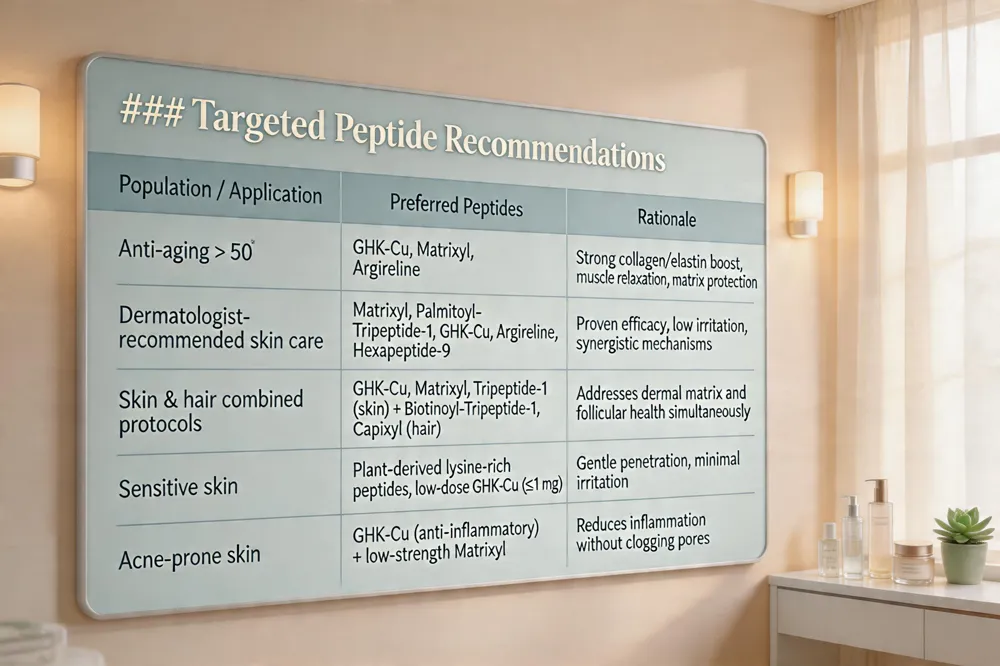 Best peptides for anti‑aging over 50 – Mature skin benefits most from copper‑tripeptide‑1 (GHK‑Cu), palmitoyl‑pentapeptide‑4 (Matrixyl®), and acetyl‑hexapeptide‑8 (Argireline®). These agents boost collagen/elastin synthesis, protect existing matrix, and relax fine‑line‑forming muscle activity. A clinically‑studied serum such as Alastin Restorative Skin Complex with TriHex+ combines these peptides with growth‑factor mimetics for firmer texture, while The Ordinary Multi‑Peptide + HA Serum offers a cost‑effective hyaluronic‑acid base that hydrates and plumps aging skin.
Best peptides for skin dermatologist‑recommended – Dermatologists favor signal peptides (Matrixyl, Palmitoyl‑Tripeptide‑1) for direct collagen stimulation, carrier peptides (GHK‑Cu for mineral delivery, and enzyme‑inhibitor peptides (Argireline, Hexapeptide‑9) to curb collagen degradation. A blended serum containing these families, followed by a peptide‑rich moisturizer (e.g., Paula’s Choice Pro‑Collagen Peptide Plumping Moisturizer), provides continuous delivery and optimal anti‑aging results.
Best peptides for skin and hair – For skin, copper GHK‑Cu, Matrixyl, and Pentapeptide‑1 support matrix remodeling and reduce inflammation. Hair‑focused peptides such as biotinoyl‑tripeptide‑1, Capixyl (peptide + flavonoid), and acetyl‑tetrapeptide‑17 stimulate follicular stem cells, improve vascular delivery, and increase density. Integrated protocols that pair skin‑repair peptides with scalp‑targeted peptides yield synergistic benefits, but a dermatologist should guide dosing and formulation.
Emerging Research and Practical Recommendations
Emerging Peptide Delivery Innovations
| Innovation | Description | Potential Benefit |
|---|---|---|
| Self‑assembled amphiphilic peptide nanostructures | Short (≈17 aa) sequences form nanofibers that fuse with stratum corneum | Enhanced penetration, protease resistance |
| Computationally designed arginine‑rich CPPs (e.g., 589WP) | Bio‑informatics identifies optimal cationic motifs | Higher transdermal flux, lower irritation |
| Peptide‑nanocarrier hybrids (peptide‑coated SLNs) | Peptide acts both as active agent and carrier surface | Dual function: protection + penetration enhancement |
| Microneedle‑pretreated peptide patches | Microneedle arrays create micro‑channels; peptide patch applied thereafter | Uniform dosing, increased bioavailability |
| Laser‑assisted peptide delivery platforms | Fractional laser creates controlled pores before peptide application | Allows larger or less‑charged peptides to reach dermis |
| Clinical trial recommendations | Conduct Phase I/II safety & efficacy studies combining novel nanostructures with microneedling | Validate real‑world performance and regulatory compliance |
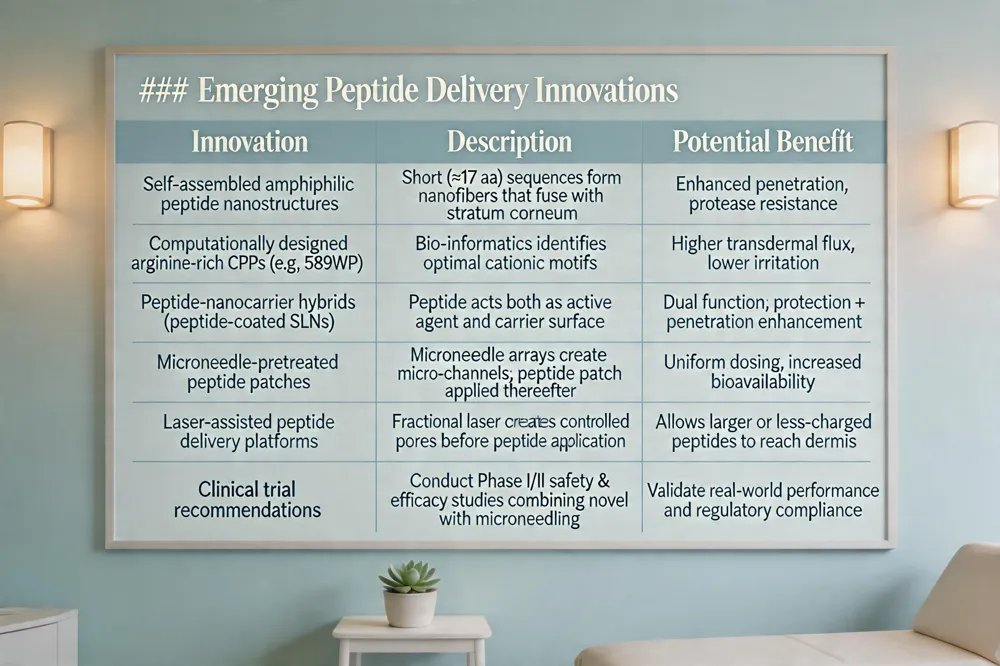 Self‑assembled peptide nanostructures are being engineered to act as both penetration enhancers and nanocarriers. Recent studies showed that short amphiphilic sequences (≈17 aa) can form stable nanostructures that fuse with the stratum corneum, and minor hydrophobic modifications dramatically improve skin‑penetration efficiency and protease resistance. Parallel computational design efforts use bio‑informatics to identify cationic, arginine‑rich motifs (e.g., optimized penetratin derivatives such as 589WP) that exhibit high transdermal flux in vitro and in vivo, guiding the creation of bespoke skin‑penetrating peptides (SPPs). Looking forward, clinical trials are needed to confirm safety, optimal dosing, and real‑world efficacy of these novel delivery platforms, especially when combined with microneedling, laser ablation, or nanocarrier formulations for anti‑aging and therapeutic applications.
Bottom Line
Peptide penetration hinges on size (<500 Da), charge, and formulation. Small, positively‑charged or lipidated peptides (e.g., palmitoyl‑pentapeptide‑4, GHK‑Cu) cross the stratum corneum more readily, while larger molecules need enhancers—chemical (oleic acid, ethanol), nanocarriers (liposomes, ethosomes), or physical methods (microneedles, iontophoresis, laser ablation). Clinically, optimized delivery translates into measurable collagen boost, wrinkle reduction, and wound‑healing benefits, but patients must choose products with proven concentrations and delivery systems to see real results. Future research points toward self‑assembling skin‑penetrating peptides, stapled or cyclic designs, and hybrid nano‑formulations that combine chemical and physical enhancers, promising safer, more efficient at‑invasive peptide therapies for anti‑aging and therapeutic dermatology.