Welcome to On The Spot Dermatology
On The Spot Dermatology in Glenview, Illinois blends board‑certified expertise with a patient‑first philosophy. Our modern clinic offers a full spectrum of services—from comprehensive skin‑cancer screenings and chronic‑condition management to advanced cosmetic procedures such as laser resurfacing, BOTOX® Cosmetic, and medical‑grade chemical peels. Every visit begins with a detailed review of your medical and skincare history, followed by a thorough full‑body examination using a dermatoscope and bright, magnifying lights. We tailor treatment plans to your unique skin type, risk factors, and aesthetic goals, integrating prescription topicals, minimally invasive surgeries, and personalized product recommendations. This guide walks you through what to bring, how to prepare, and what to expect during the appointment, ensuring you feel confident, informed, and ready for an optimal outcome. By combining preventive care with cutting‑edge interventions, we help you achieve lasting skin health and a radiant appearance.
Preparing for Your First Dermatology Appointment
Quick Prep Checklist
| Recommendation | Details |
|---|---|
| Skip heavy cosmetics | Remove makeup, nail polish, scented lotions, sunscreen, moisturizers. |
| Stop actives | Discontinue retinoids, AHAs, BHAs, benzoyl peroxide, acne spot treatments ≥48 h before. |
| Avoid recent procedures | No waxing, threading, peels, laser resurfacing, or facial treatments. |
| Dress appropriately | Wear loose, breathable clothing; a gown will be provided for a full‑body exam. |
| Shower | Use a mild cleanser; keep skin clean and hydrated. |
| Bring essentials | List of meds, skincare products, supplements, and photos of concerning lesions. |
| Do NOT | Start new topicals, pick/squeeze lesions, cover suspicious spots, shave/wax areas to be examined. |
| Key questions | Genetics/hormones/sun exposure, best treatment options, side‑effects, timeline, follow‑up. |
| Avoid habits | Skipping sunscreen, overly complex regimens, triple‑antibiotic creams, picking, harsh scrubs, many new products, “miracle” cures. |
| 1 % rule | Ingredients >1 % must be listed in descending order; ≤1 % can be any order. |
 Before you go, skip heavy makeup, nail polish, scented lotions and any sunscreen or moisturizers that could mask skin findings. Stop strong actives—retinoids, AHAs, BHAs, benzoyl peroxide or acne spot treatments—at least 48 hours before the visit, and avoid recent waxing, threading, or facial procedures like peels or laser resurfacing. Wear loose, breathable clothing (a gown will be provided for a full‑body exam) and shower with a mild cleanser to keep the skin clean and hydrated. Bring a list of all prescription and over‑the‑counter medications, skincare products, supplements, and any photos of concerning lesions.
Do not start new topical treatments, pick or squeeze lesions, or cover suspicious spots with heavy makeup or concealer. Also, refrain from shaving or waxing the areas to be examined right before the appointment.
Key questions to ask: What factors (genetics, hormones, sun exposure) are driving my skin issue? Which treatment options—topicals, procedures, injectables—are best for my skin type? What are the side‑effects, timeline for improvement, and recommended follow‑up schedule?
Dermatologists warn against seven habits: skipping daily sunscreen, using overly complex multi‑step regimens, applying triple‑antibiotic creams, picking pimples, over‑using harsh scrubs, introducing many new products at once, and relying on “miracle” cures without medical guidance.
The 1 % rule: Ingredients above 1 % must be listed in descending order; those at or below 1 % can appear in any order, helping you spot which actives are truly present in meaningful amounts.
The Full‑Body Skin Examination Experience
Exam Flow & Timing
| Aspect | Details |
|---|---|
| Overall duration | 30‑45 min total; skin exam 10‑20 min, extended 30‑45 min if specific concerns addressed. |
| Equipment | Bright lights, dermatoscope, handheld camera. |
| Areas covered | Scalp to toe, including groin & perianal regions (routine inspection). |
| What dermatologists look for | ABCDE criteria for moles, redness, bumps, hives, dry patches, infections, chronic disease signs. |
| Biopsy | Performed on spot with local anesthesia if lesion suspicious. |
| Documentation | Written summary, prescriptions, procedural referrals, follow‑up plan. |
| Patient prep | Change into gown, remove jewelry, makeup, nail polish. |
| Special requests | Extra time for groin/perianal inspection if concerned. |
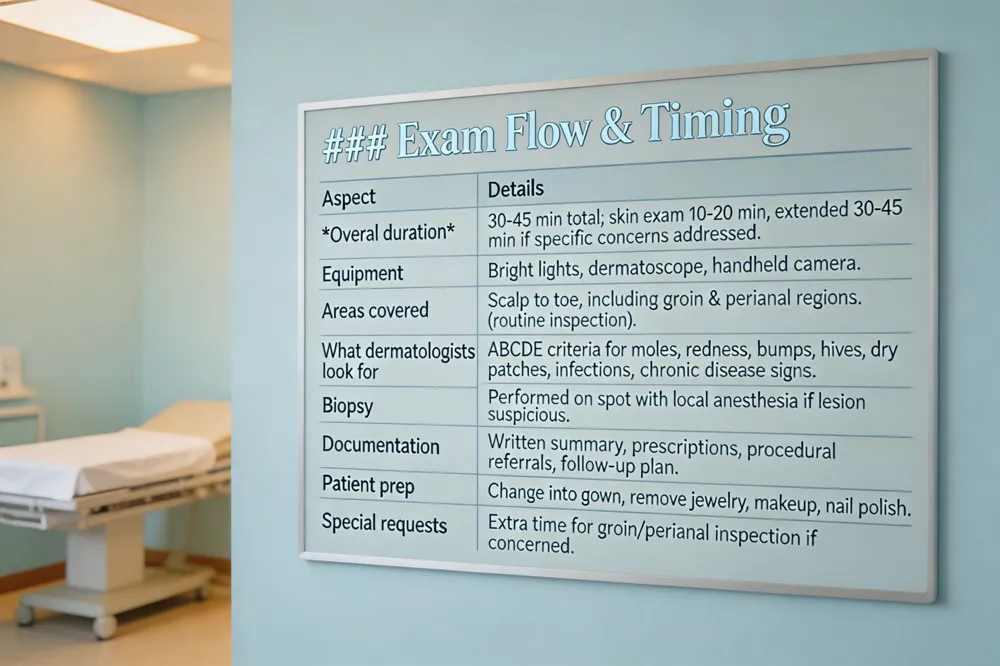 A full‑body skin exam is the cornerstone of a first dermatology visit. After you check into the clinic and fill out any new‑patient paperwork, the dermatologist reviews your medical history—including family skin‑cancer history, sun exposure, medications, and current skin‑care products. You will be asked to change into a loose‑fitting gown and remove jewelry, makeup, and nail polish so the skin can be examined unobstructed.
Overall exam flow and timing – The clinician uses bright lights, a dermatoscope (or other magnifier), and sometimes a handheld camera to assess every region from scalp to toe. For routine mole or skin‑cancer screening the examination typically lasts 10‑20 minutes, while a visit that also addresses a specific concern (acne, warts, eczema, etc.) may extend to 30‑45 minutes overall. The entire first appointment, including history review and discussion of findings, usually fits within a 30‑45‑minute window, though some practices schedule up to an hour for complex cases.
Inclusion of groin and perianal areas – Dermatologists routinely inspect the groin and perianal regions as part of the full‑body check‑up. These sites can harbor fungal infections, dermatitis, warts, or early skin‑cancer lesions that are easy to miss without a dedicated look. If you have specific concerns, you can request extra time for a careful inspection.
What the dermatologist looks for during the exam – The doctor evaluates moles, lesions, and skin texture for asymmetry, border irregularities, color changes, diameter, and evolution (ABCDE criteria). They also check for redness, bumps, hives, dry patches, and any signs of infection or chronic disease. Suspicious lesions may be examined with a dermatoscope and, if needed, a skin biopsy is performed after local numbing.
How long the first appointment typically lasts – Most first visits last between 30 and 45 minutes; a comprehensive skin exam alone can be 10‑20 minutes, with additional time for history taking, discussion of treatment options, and any procedural work such as a biopsy.
What happen at a first dermatologist appointment overall – During your first dermatology visit, the doctor will ask detailed questions about your medical background, skin‑care routine, and any specific concerns or symptoms you’ve noticed. They will then perform a thorough visual inspection of your skin, using a dermoscope if needed to examine any lesions or moles up close. Based on what they see and what you describe, the dermatologist will discuss possible diagnoses, treatment options, and any lifestyle or skincare changes that could help. You’ll receive a written summary of the findings, along with any prescriptions, topical recommendations, or procedural referrals that are appropriate. Finally, the doctor will outline a follow‑up plan, scheduling future appointments or monitoring as needed to track your progress.
How long does a first dermatologist appointment take – A first‑time dermatology visit usually lasts between 30 and 45 minutes, though some practices may schedule up to an hour for more complex concerns. During this time the dermatologist will take a detailed medical history, perform a full skin examination, and discuss any findings or questions you have. If the appointment includes a skin‑cancer screening, mole evaluation, or a cosmetic procedure consultation, a few extra minutes may be added for additional testing or imaging. The clinician will then outline a treatment plan, prescribe medications if needed, and schedule any follow‑up or procedural appointments. Overall, you can expect a focused yet thorough encounter that fits within a typical half‑hour to three‑quarter‑hour window.
Do dermatologists examine the groin area? – Yes, dermatologists routinely examine the groin and perianal regions as part of a thorough skin assessment, especially during a full‑body check‑up. This area can be prone to various conditions—such as fungal infections, dermatitis, warts, or early signs of skin cancer—so a visual inspection helps catch problems early. At our Glenview practice, we include the groin in routine mole checks, skin‑cancer screenings, and any targeted evaluation you request. If you have specific concerns about the groin, let the dermatologist know ahead of time so we can dedicate extra time to a careful inspection. A comprehensive exam ensures no part of your skin is overlooked, supporting both health and aesthetic goals.
Skin Cancer Screening and Biopsy Process
Screening & Biopsy Overview
| Step | Details |
|---|---|
| History review | Personal/family skin‑cancer history, sun exposure, meds, prior lesions. |
| Full‑body exam | Bright light + dermatoscope; ABCDE melanoma check. |
| Suspicious lesion | Immediate shave, punch, or excisional biopsy after local anesthetic. |
| Result turnaround | 4‑10 days for pathology report. |
| Follow‑up | Discuss results, personalized monitoring/treatment plan, self‑check tips, sun protection. |
| 2‑week rule | Referral for high‑risk skin cancer must be scheduled within 14 days; treatment initiation within 62 days. |
| On‑site care | Gown change, exam, possible biopsy in same visit at On The Spot Dermatology (Glenview, IL). |
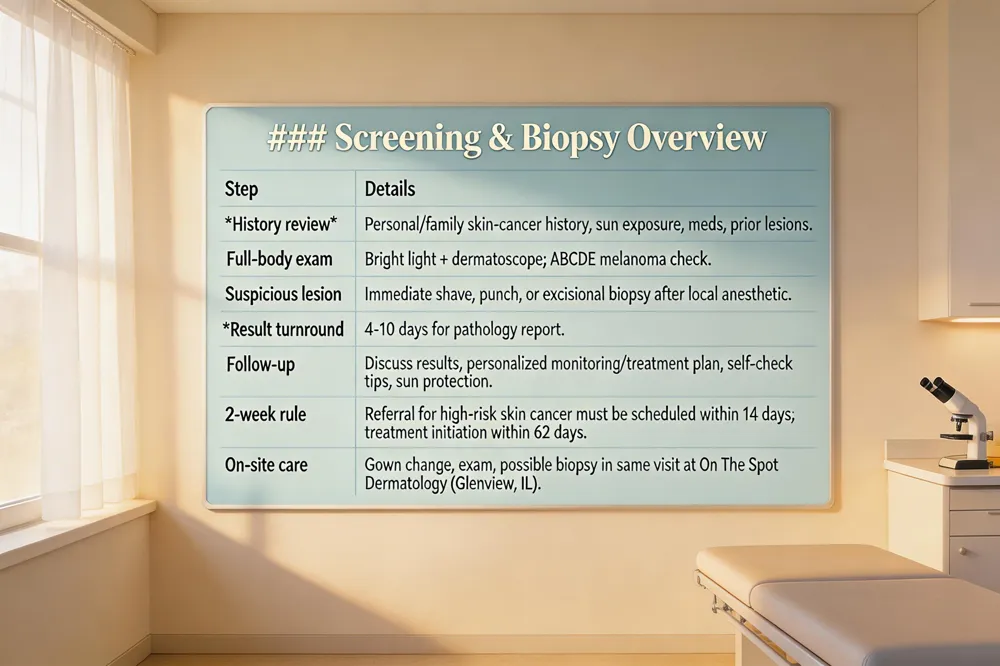 When you schedule your first skin‑cancer visit at On The Spot Dermatology in Glenview, IL, the dermatologist begins with a detailed review of your personal and family medical history, sun‑exposure habits, and any previous lesions. A full‑body skin examination follows, during which the clinician uses a bright light and a dermatoscope—a handheld magnifier with illumination—to scrutinize each mole, spot, or patch for the classic ABCDE warning signs of melanoma and other cancers.
If a lesion looks suspicious, a biopsy is performed on the spot. Common types include shave, punch, or excisional biopsies, each removed after a local anesthetic injection to minimize discomfort; stitches may be needed for larger samples. Results are typically available within 4 to 10 days, after which the dermatologist contacts you to discuss the pathology report and a personalized follow‑up plan, which may involve additional monitoring, treatment, or surgery.
What to expect at your first dermatologist appointment for skin cancer
At On The Spot Dermatology, you will be asked to change into a gown, undergo the full‑body skin examination with dermatoscopic magnification, and, if needed, have a biopsy taken during the same visit. The doctor will explain your risk factors, review biopsy results when ready, and provide a tailored monitoring and treatment strategy, including self‑check tips and sun‑protection advice.
What is the 2‑week rule for skin‑cancer referrals?
The “2‑week rule” requires primary‑care clinicians to arrange a specialist dermatology appointment within 14 days when a high‑risk skin cancer is suspected. This rapid‑access pathway aims to reduce diagnostic delays, ensure early evaluation, and facilitate treatment initiation as soon as possible, typically within 62 days of the original referral.
Managing Specific Skin Concerns: Acne, Moles, and Psoriasis
Concern‑Specific Visits
| Concern | Typical Visit Content |
|---|---|
| Acne | Health questionnaire, visual exam (face, chest, back), discuss hormonal/bacterial/inflammatory causes, treatment options (topicals, oral meds, hormonal therapy, in‑office procedures), 4‑6 wk follow‑up. |
| Moles | History & change inquiry, dermoscopic ABCDE assessment, biopsy/excision if atypical, 4‑10 day result timeline, follow‑up plan. |
| Psoriasis | Trigger review, full‑body exam, PASI/BSA scoring, baseline photos, treatment options (topicals, vitamin D analogues, phototherapy, systemic/biologic), possible biopsy/blood work/rheumatology referral, personalized care plan & follow‑up. |
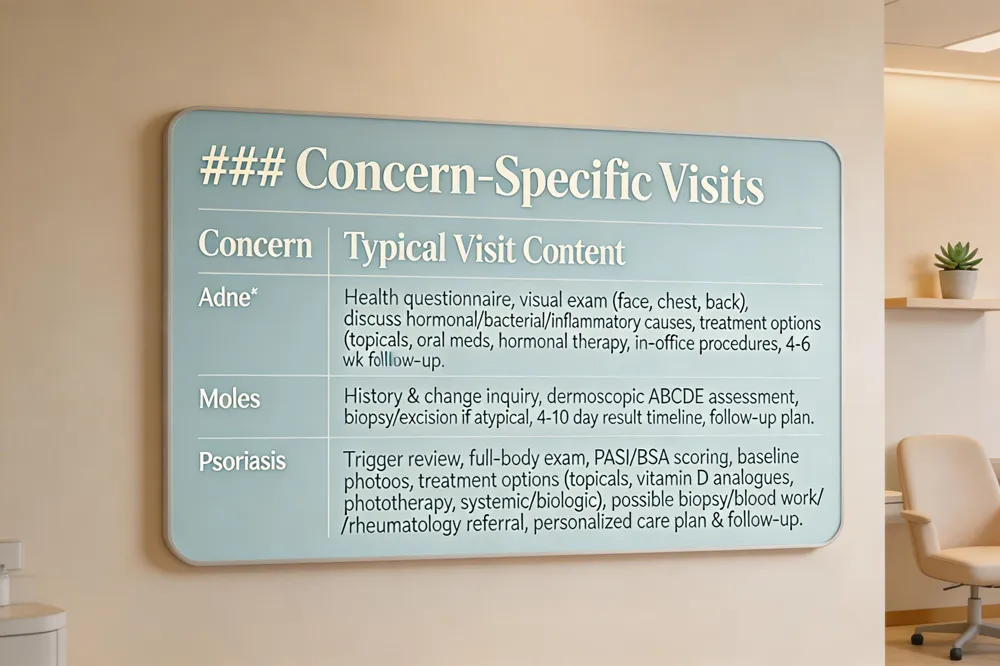 During your first acne visit the dermatologist will review a brief health questionnaire covering your current skin‑care routine, medications, diet, stress and past acne treatments. A visual exam of the face, chest, shoulders and back identifies lesion type, severity and any scarring. The doctor explains underlying causes—hormonal, bacterial, inflammatory or lifestyle—and discusses evidence‑based options such as topical retinoids, benzoyl peroxide, oral antibiotics, hormonal therapy or in‑office procedures like chemical peels or laser treatment. A personalized treatment plan, written product instructions and a scheduled follow‑up (usually 4‑6 weeks) are provided to monitor progress.
For a mole appointment the clinician first reviews your medical and family history and asks about changes (itching, bleeding, growth). Using a dermoscope, the dermatologist applies the ABCDE criteria to assess size, shape, color, border and symmetry. If the lesion is atypical, a quick biopsy or excision is performed with local anesthesia, and the tissue is sent for pathology. You receive a clear timeline for results (4‑10 days) and a follow‑up to discuss findings and any further management.
At a psoriasis visit the dermatologist evaluates flare‑triggering factors, then conducts a full‑body exam, scoring plaque extent with the PASI or BSA index and photographing lesions for baseline tracking. Treatment options—topical steroids, vitamin D analogues, phototherapy, systemic drugs or biologic injections—are tailored to disease severity and lifestyle. If indicated, a skin biopsy, blood work or rheumatology referral for psoriatic arthritis is arranged. The visit ends with a customized care plan, prescription instructions and tips for trigger management, plus a follow‑up schedule to assess response and adjust therapy.
Optimizing Skin Health for Special Occasions
Event‑Ready Skin Routine
| Timing | Action |
|---|---|
| 5‑7 days before | Gentle chemical peel or light laser resurfacing (board‑certified dermatologist). |
| Night before | Hydrating mask or Signature HydraFacial; Vitamin C serum in the morning. |
| Morning of event | Lightweight luminous moisturizer with hyaluronic acid, then SPF 30+ (or SPF 50+ for extra protection). |
| Evening before | Double‑cleanse, Vitamin C serum, antioxidant‑rich sheet mask. |
| Daily | Broad‑spectrum SPF 50+ sunscreen, stay hydrated, adequate sleep, brief facial massage for circulation. |
| Finish | Subtle highlighter on cheekbones for dewy finish. |
 Preparing for a party or wedding is easier when you combine a few evidence‑based skin‑care steps with professional treatments.
Best skin treatment before an event Schedule a gentle chemical peel or a light laser resurfacing 5–7 days ahead of the occasion at a board‑certified dermatologist or reputable spa in Glenview. The peel removes dull surface cells, while the laser stimulates collagen for smoother texture. Follow the procedure with a hydrating mask or a Signature HydraFacial the night before to lock in moisture. Throughout the week, use a Vitamin C serum in the morning and a hyaluronic‑acid moisturizer at night, and finish each day with a broad‑spectrum SPF 50+ sunscreen to protect the newly refreshed skin.
How to get glowing skin before a party The evening before, double‑cleanse, apply a Vitamin C serum, and place an antioxidant‑rich sheet mask on the face. In the morning, moisturize with a lightweight, luminous cream containing hyaluronic acid, then apply SPF 30+ sunscreen. A subtle highlighter on the cheekbones adds a dewy finish. Stay well‑hydrated, get adequate sleep, and consider a brief facial massage to boost circulation for a quick, radi‑ boost.
These combined at‑home and in‑office steps create a luminous, even complexion that lasts through any special occasion.
Your Next Steps After the First Visit
After your initial dermatology appointment, the dermatologist will usually suggest a personalized follow‑up schedule based on the findings—whether it’s a routine annual skin check, a sooner review for a suspicious lesion, or a series of visits for acne, eczema, or cosmetic treatments. In the meantime, perform regular self‑checks at home: examine your scalp, ears, between your toes, and any areas you can easily see, and note any new or changing moles, rashes, or lesions. Keep a brief skin diary and photos to share at the next visit. Maintain a balanced skincare routine that respects your skin type and any prescribed treatments; gentle cleansers, fragrance‑free moisturizers, and a broad‑spectrum SPF 30+ sunscreen applied daily are essential. Remember to re‑apply sunscreen every two hours when outdoors, seek shade during peak UV hours, and wear protective clothing and hats. Consistent self‑care and timely follow‑ups give your dermatologist the data needed to detect problems early and tailor the most effective, personalized plan for healthy, radiant skin.