AI and Rare Dermatology: Transforming Diagnosis
Artificial intelligence in dermatology relies on deep‑learning convolutional neural networks trained on millions of labeled skin images. These models learn visual patterns far beyond the traditional ABCDE criteria, enabling them to flag subtle features of rare disorders such as atypical melanocytic nevi, cutaneous T‑cell lymphoma, or epidermolysis bullosa. Diagnosing rare skin diseases is difficult because clinicians see few cases, image datasets often under‑represent diverse skin tones, and histopathology is frequently required. AI‑augmented workflows address these challenges by providing rapid, second‑opinion risk scores, integrating image analysis with electronic health records, and continuously learning from new cases. The result is higher sensitivity and specificity for non‑specialists, quicker triage of high‑risk lesions, reduced unnecessary biopsies, and earlier specialist referral, ultimately improving patient outcomes and clinician satisfaction.
AI‑Driven Skin Scanners and Their Performance
AI‑Driven Skin Scanners – Key Performance Metrics
| Metric | Value | Source |
|---|---|---|
| Sensitivity (without AI) | 75 % | Stanford Medicine meta‑analysis |
| Sensitivity (with AI) | 81.1 % | Stanford Medicine meta‑analysis |
| Specificity (without AI) | 81.5 % | Stanford Medicine meta‑analysis |
| Specificity (with AI) | 86.1 % | Stanford Medicine meta‑analysis |
| Condition coverage | Up to 58 conditions | Product documentation |
| Validation accuracy | >97 % | Multiple validation studies |
AI raises both sensitivity and specificity, especially for non‑specialists.
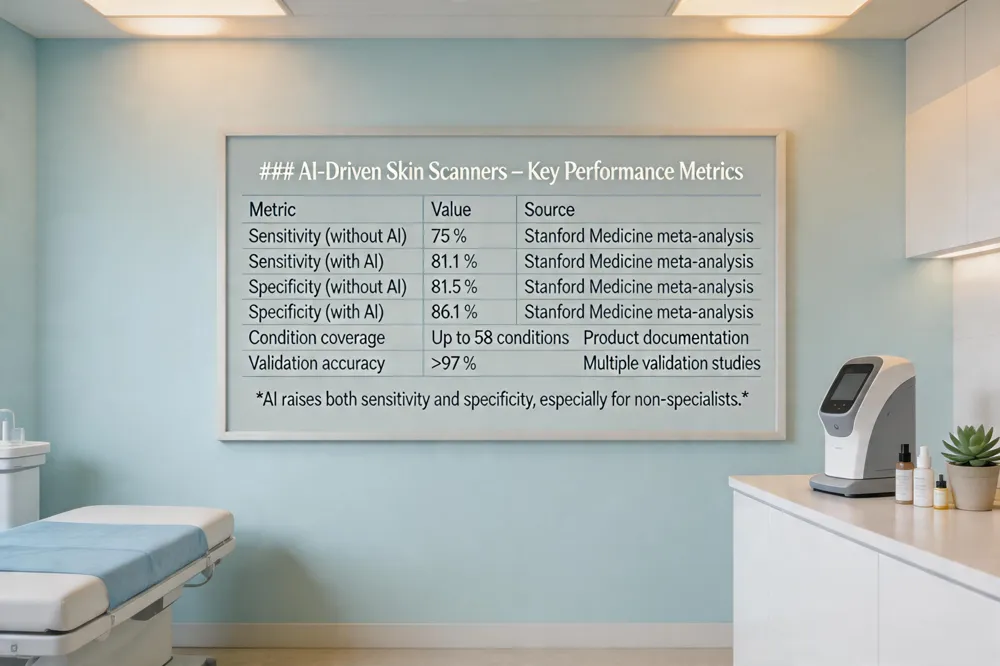 AI‑driven skin scanners use deep‑learning convolutional neural networks trained on hundreds of thousands of dermatologist‑labeled images. A patient photographs a lesion—often three well‑lit pictures from under 10 cm distance—and the algorithm evaluates thousands of visual features (color, border, texture, pattern) far beyond the classic ABCDE criteria. Within a minute it generates a risk score and a short PDF report that lists up to 58 possible conditions, including melanoma, basal‑cell carcinoma, and many benign lesions, with reported accuracies above 97 % in validation studies.
Accuracy and condition coverage – Large‑scale trials (e.g., Stanford Medicine, 12 studies, >67 000 evaluations) show AI assistance raises sensitivity from 75 % to 81.1 % and specificity from 81.5 % to 86.1 %, especially for non‑specialists. AI models also achieve >90 % accuracy for rare disorders such as cutaneous lymphoma and epidermolysis bullosa, and they can flag atypical lesions that clinicians might miss.
Practical usage tips for patients – Use clear, focused images on a plain background; capture three angles of the same area. Treat the AI output as a preliminary screen, not a final diagnosis. Follow up with an in‑person exam by a board‑certified dermatologist (e.g., On The Spot Dermatology) to confirm any concerns, discuss treatment, and ensure safe care.
FAQs
- AI dermatologist: skin scanner: The scanner provides an instant risk assessment for over 58 conditions, but a professional evaluation is required for definitive diagnosis.
- Skin scanner online free: Free tools (e.g., Skinive’s Mole Checker) give a quick risk score; they are useful for screening but not a replacement for a dermatologist.
- AI dermatology app: Apps allow self‑monitoring and provide PDF reports, yet they are not diagnostic devices and should be used only as an adjunct to professional care.
- Is AI dermatologist legit?: AI offers valuable insights but cannot replace a board‑certified dermatologist; it should be viewed as a screening aid.
- Is AI dermatologist accurate?: Studies show AI can match or exceed dermatologist performance in controlled settings, improving sensitivity and specificity, yet clinical oversight remains essential.
Free Photo‑Based AI Assessments
Free Photo‑Based AI Assessments – Quick Comparison
| Service | Conditions Covered | Accuracy Estimate | Limitations |
|---|---|---|---|
| Skinive Mole Checker | 58 | ~80 % (screening) | No clinical exam, limited scans per day |
| Skin Image Search™ | 50 | ~75 % (screening) | Images stored temporarily, may miss subtle findings |
| AI Dermatology App (generic) | 58+ | ~70‑80 % (varies) | Not a diagnostic device, requires follow‑up |
These tools are useful for early awareness but should never replace a board‑certified dermatologist.
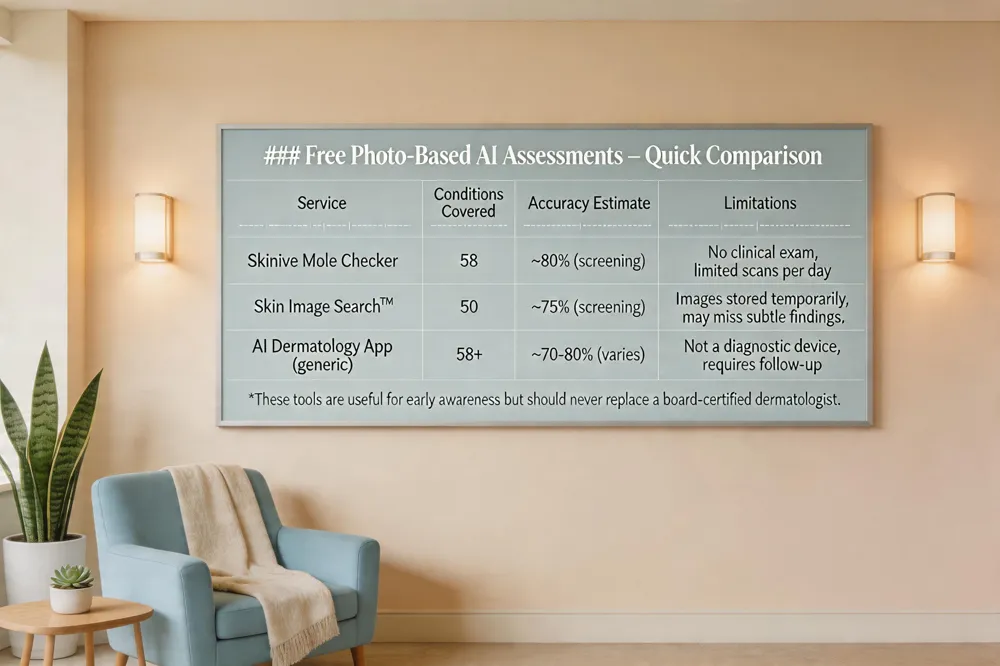 Free AI skin‑analysis tools let you upload a clear, well‑lit photo of a lesion and instantly compare it to a large, curated image database. Within seconds the algorithm returns a short list of possible conditions, offering early awareness but not a medical diagnosis. These consumer‑grade apps act as image‑matching search engines; they lack physical examination, histopathology, and the ability to consider full clinical history, so subtle or serious findings can be missed. Accuracy varies, and many services limit scans per day or store images only temporarily. Because of these limitations, any concerning result—or any lingering doubt—should prompt a visit to a board‑certified dermatologist. An in‑person or tele‑dermatology appointment provides a thorough exam, biopsy if needed, and a personalized treatment plan. At On The Spot Dermatology we combine expert clinical assessment with advanced imaging to go beyond the brief guidance of free photo‑analysis services.
Clinical Integration and Augmented Intelligence
Clinical Integration of AI in Dermatology
| Application | Benefit | Example |
|---|---|---|
| Triage & risk scoring | ↑ Sensitivity (75 % → 81.1 %) | Stanford Medicine study |
| Tele‑dermatology workflow | Expanded access in underserved areas | On The Spot Dermatology AI assistant |
| Documentation automation | Instant PDF reports with differential list | Consumer‑grade apps (e.g., Skinive) |
| Decision support | Highlights atypical patterns beyond ABCDE | PanDerm multimodal model |
AI acts as an “augmented intelligence” layer that clinicians review before final diagnosis.
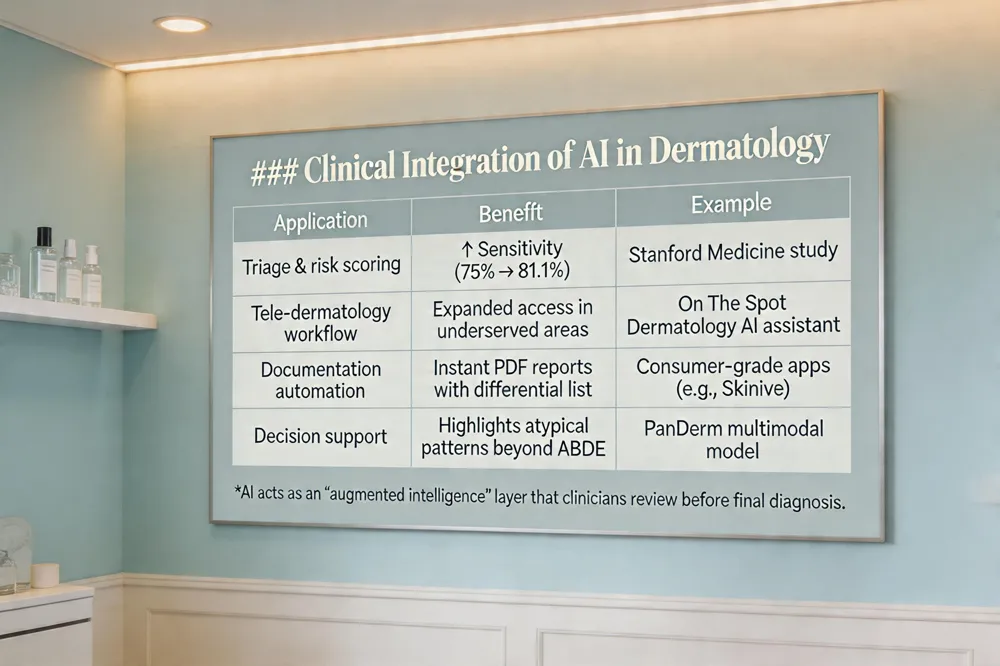 Artificial intelligence (AI) is now a core decision‑support tool in dermatology, turning millions of labeled lesion images into rapid risk scores that clinicians review before final diagnosis. By flagging suspicious patterns beyond the traditional ABCDE criteria, AI boosts sensitivity from 75% to 81.1% and AI raises diagnostic specificity from 81.5% to 86.1% in skin‑cancer screening, while also improving rare‑disease detection for conditions such as atypical melanocarcinoma and epidermolysis bullosa.
Artificial intelligence in dermatology ppt – A concise PowerPoint would introduce deep‑learning fundamentals, showcase clinical performance metrics (e.g., >85% sensitivity for melanoma), and illustrate real‑world case studies where AI‑driven triage reduced diagnostic latency by up to 40%.
AI in dermatology – AI augments clinicians by providing instant differential‑diagnosis lists, standardizing documentation, and enabling tele‑dermatology workflows that expand access, especially in underserved areas.
AI dermatologist review – Consumer‑grade AI apps can assess >58 conditions with >97% accuracy, delivering PDF reports within a minute; however, they remain screening tools and must be confirmed by a board‑certified dermatologist.
Artificial intelligence in dermatology: a review of methods, clinical applications, and perspectives – Deep‑learning CNNs, multimodal foundation models (e.g., PanDerm) and federated learning are driving accurate image classification, automated documentation, and personalized treatment recommendations, while ongoing research emphasizes bias mitigation, explainability, and regulatory compliance to ensure safe, equitable integration into everyday practice.
AI for Rare Skin Disorder Diagnosis
AI Accuracy for Rare Skin Disorders
| Disorder | AI Accuracy | Dermatologist Comparison | Reference |
|---|---|---|---|
| Cutaneous lymphoma | 90 % | Comparable to expert | AI‑augmented teledermatology study |
| Epidermolysis bullosa | 90 % | Comparable to expert | AI‑augmented teledermatology study |
| Pemphigus vulgaris | 88 % | Slightly lower than expert | AI‑augmented teledermatology study |
| Ichthyosis | 85 % | Slightly lower than expert | AI‑augmented teledermatology study |
AI platforms can flag rare disorders early, improving referral timing.
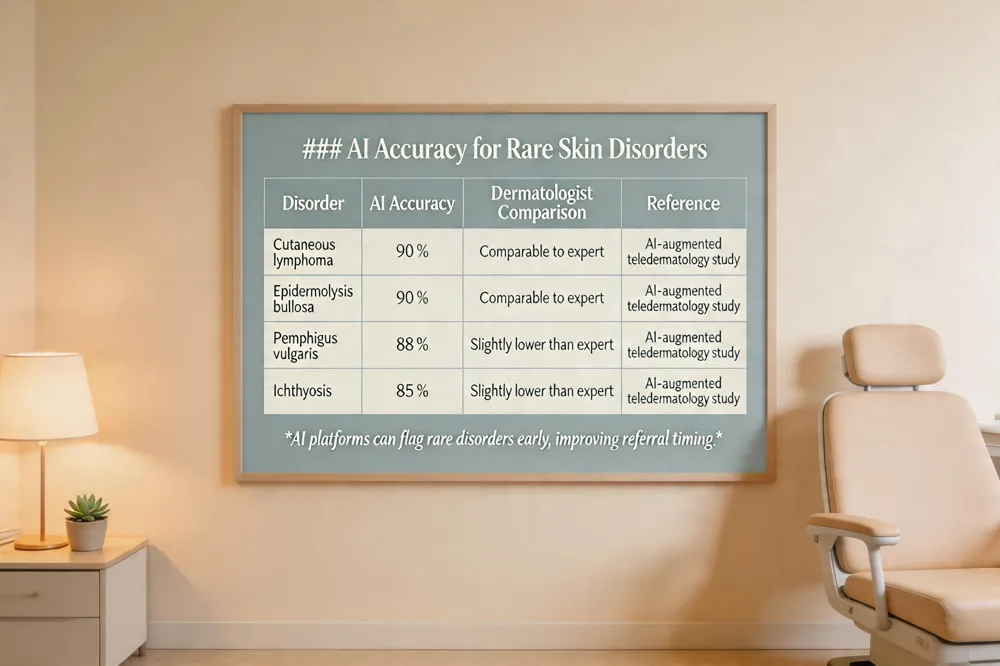 Artificial intelligence (AI) is emerging as a powerful "augmented intelligence" tool to help dermatologists diagnose rare skin disorders earlier. By training deep‑learning models on large registries such as AI as augmented intelligence in teledermatology for early diagnosis of rare skin disorders (over one million patients), AI can scan dermatology visits, primary‑care notes, and emergency‑room records to spot subtle patterns that signal conditions like AI models trained on large registries like DataDerm with over one million patients, epidermolysis bullosa, pemphigus vulgaris, and ichthyosis. Clinical studies, including a AI improves skin cancer diagnostic accuracy for clinicians and peer‑reviewed analyses in Artificial intelligence (AI) tools have achieved up to 90% accuracy and 85% sensitivity in melanoma detection and Artificial intelligence (AI) algorithms used in dermatology are trained on large, curated image datasets, show AI‑assisted accuracy comparable to expert dermatologists, with improvements of up to 13 percentage points in sensitivity for Medical students, nurse practitioners, and primary‑care physicians gain ~13 points sensitivity, ~11 points specificity with AI assistance. AI platforms such as On The Spot Dermatology integrates AI for rapid second‑opinion analyses provide rapid second‑opinion risk scores, flagging atypical lesions for timely referral. While AI augments, not replaces, clinical judgment, its integration promises earlier treatment, reduced diagnostic delays, and Training on diverse skin tones improves diagnostic equity for rare disorders.
Regulatory, Ethical, and Practical Considerations
Regulatory & Ethical Landscape
| Region | Device | Clearance Type | Key Concern |
|---|---|---|---|
| United States | DermaSensor, DermExpert, DERM system | FDA 510(k) / de novo | Bias toward lighter Fitzpatrick types |
| Europe | DermExpert, DERM system | CE‑mark (Class I/IIa) | Data privacy, GDPR compliance |
| Global | All AI‑enabled dermatology tools | Ongoing FDA & MDR updates | Explainability & transparent validation |
Robust privacy safeguards (HIPAA, GDPR) and bias mitigation are critical for safe deployment.
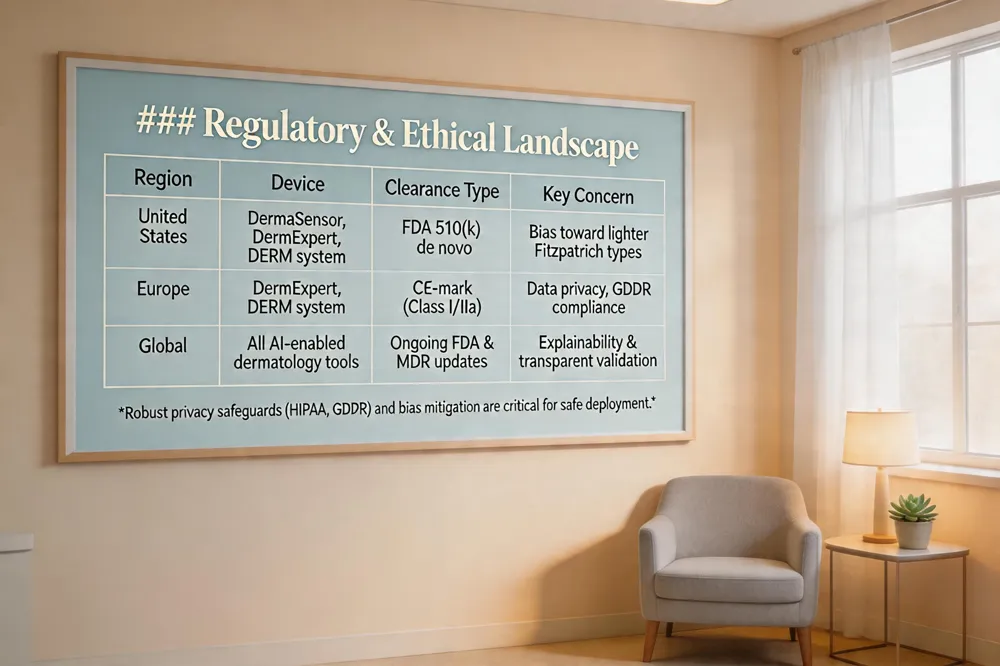 AI tools for dermatology have begun receiving formal clearances. In the U.S., the FDA has approved several AI‑enabled devices—such as DermaSensor, DermExpert, and the DERM system—under 510(k) or de novo pathways, confirming safety when used as adjuncts. In Europe, many platforms carry CE‑marks (Class I or IIa) and transition to MDR 2a, ensuring compliance with EU medical‑device standards. Bias remains a concern; most training sets under‑represent darker Fitzpatrick skin types, risking reduced accuracy for patients of color. Robust privacy safeguards—HIPAA‑compliant encryption, GDPR‑aligned de‑identification, and strict data‑use agreements—are required to protect images and health records. Clinically, AI augments practice by triaging lesions, shortening time to diagnosis, and reducing paperwork, yet final decisions stay with the dermatologist, preserving and supporting the patient‑physician relationship in modern clinical settings today.
Future Directions, Accuracy, and Patient Impact
Future Directions & Patient Impact
| Metric | Pooled Sensitivity | Pooled Specificity | Comment |
|---|---|---|---|
| Melanoma AI (meta‑analysis) | 0.86 | 0.94 | Non‑inferior to expert dermatologists |
| Overall skin‑cancer AI (Stanford) | 81.1 % (with AI) | 86.1 % (with AI) | Improves specialist‑level performance |
| Patient confidence (survey) | High (majority feel reassured) | – | Still prefer board‑certified dermatologist for final decision |
| Emerging platforms | Continuous learning, diverse training sets | – | Aim to reduce bias and improve equity |
Rapid, data‑backed risk scores boost confidence, but professional validation remains essential.
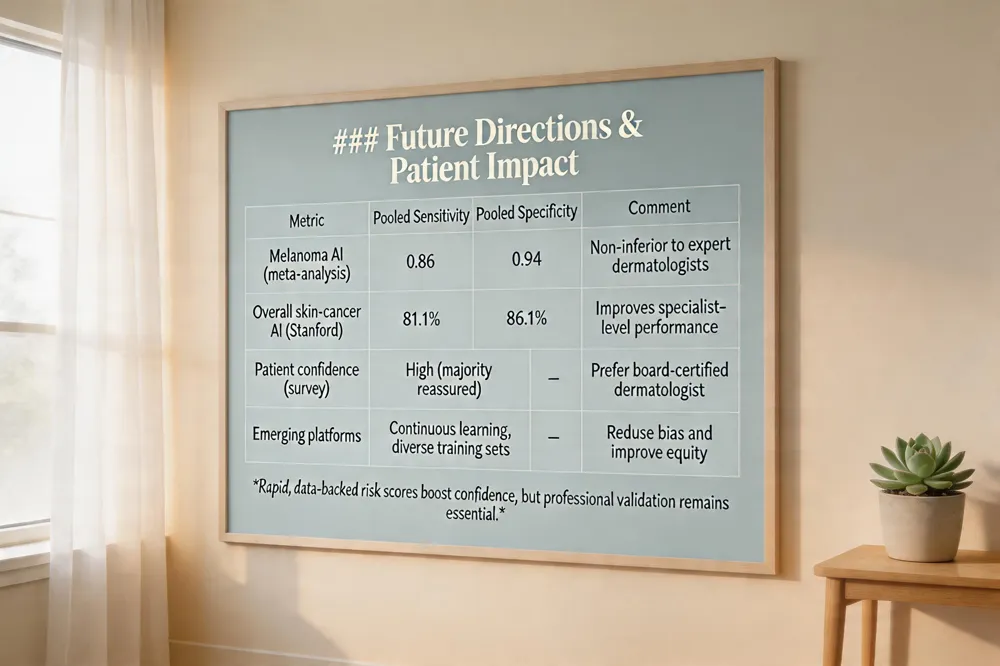 AI tools are reshaping dermatology by delivering measurable gains in skin‑cancer detection and expanding access to rare‑disease expertise. In the Stanford Medicine meta‑analysis of 12 trials (>67 000 evaluations), clinician sensitivity rose from 75 % to 81.1 % and specificity from 81.5 % to 86.1 % when AI assistance was used, with non‑specialists gaining roughly 13‑point sensitivity and 11‑point specificity improvements. Meta‑analyses of melanoma AI report pooled sensitivity ≈0.86 and specificity ≈0.94, confirming non‑inferiority to expert dermatologists. Patient confidence grows as AI delivers rapid, data‑backed risk scores, yet surveys show most users still prefer a board‑certified dermatologist for final decisions. Emerging platforms—such as Dermatology AI, Skin Image Search™, and FDA‑cleared DermaSensor—provide instant second‑opinion scores, integrate with teledermatology workflows, and continue to evolve through continuous learning and diverse training datasets.
Balancing AI Innovation with Expert Care
Artificial intelligence (AI) now serves as a powerful adjunct in dermatology, instantly analyzing lesions and flagging high‑risk patterns that clinicians may miss. Yet the technology is not a replacement; board‑certified dermatologists remain essential for interpreting AI outputs, integrating patient history, performing dermoscopy, and confirming diagnoses with biopsy when needed. This collaborative model ensures safety, explainability, and personalized care. Looking ahead, AI‑driven platforms trained on diverse, rare‑disease image libraries promise earlier detection of conditions such as atypical melanocytic nevi, cutaneous lymphomas, and epidermolysis bullosa. Continuous learning from real‑world cases will refine accuracy, but clinician oversight will always be the final arbiter of patient treatment. Future integration with electronic health records will streamline workflow, making AI insights instantly accessible during visits.