Introduction
The purpose of this article is to give patients a clear, evidence‑based overview of modern non‑surgical facial rejuvenation options, focusing on how treatments such as neuromodulators (e.g., Botox®), platelet‑rich plasma (PRP), microneedling, and hyaluronic‑acid fillers work together to improve skin texture, tone, and firmness. We will cover the scope of cosmetic dermatology—from minimally invasive injectables that temporarily relax dynamic wrinkles to regenerative therapies that stimulate natural collagen and elastin production—while emphasizing the importance of personalized care plans, board‑certified providers, and safe, FDA‑approved procedures. By understanding the mechanisms, typical outcomes, and safety considerations of each modality, readers can make informed decisions about the most appropriate treatment pathway for their aesthetic goals.
Main Content
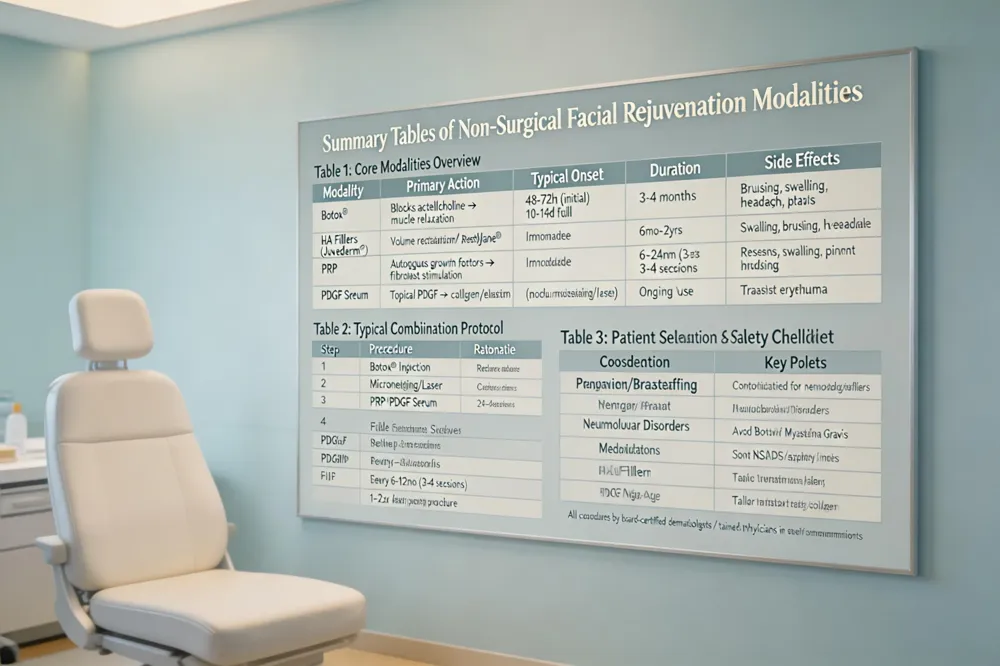
Summary Tables of Non‑Surgical Facial Rejuvenation Modalities
Table 1: Core Modalities Overview
| Modality | Primary Action | Typical Onset | Duration of Effect | Common Side Effects |
|---|---|---|---|---|
| Botox® (onabotulinumtoxinA) and Neuromodulator – blocks acetylcholine release → muscle relaxation | 48–72 h (initial) – full effect 10–14 d | 3–4 months | Bruising, swelling, headache, transient eyelid ptosis | |
| Hyaluronic‑Acid Fillers (e.g., Juvederm®, Restylane®) | Volume restoration – collagen scaffold | Immediate (post‑injection) | 6 months – 2 years (product‑dependent) | Swelling, bruising, rare nodules; reversible with hyaluronidase |
| Platelet‑Rich Plasma (PRP) | Autologous growth‑factor delivery → fibroblast stimulation | Immediate post‑microneedling | 6–24 months (requires 3–4 sessions) | Mild redness, swelling, pinpoint bruising |
| Engineered PDGF Serum | Topical recombinant PDGF → collagen & elastin synthesis | Immediate (post‑microneedling/laser) | Ongoing with regular use (months) | Minimal; possible transient erythema |
Table 2: Typical Combination Protocol
| Step | Procedure | Rationale |
|---|---|---|
| 1 | Botox® injection | Reduce dynamic wrinkles before any skin‑surface work |
| 2 | Microneedling (or laser resurfacing) | Create micro‑channels for enhanced delivery of subsequent agents |
| 3 | PRP or Engineered PDGF Serum application | Boost collagen remodeling and improve texture |
| 4 | Hyaluronic‑Acid filler placement | Restore lost volume and smooth static lines |
Table 3: Patient Selection & Safety Checklist
| Consideration | Key Points |
|---|---|
| Pregnancy / Breastfeeding | Contraindicated for neuromodulators and fillers |
| Neuromuscular Disorders | Avoid botulinum toxin if disease such as Myasthenia Gravis |
| Medications | Discontinue NSAIDs, aspirin, anticoagulants 24–48 h before injections to reduce bruising |
| Blood‑borne Infections | Exclude for PRP (active infections, anemia, anticoagulation) |
| Skin Type & Age | Tailor filler volume and PRP/PDGF frequency based on skin laxity and collagen baseline |
Table 4: Maintenance Schedule Overview
| Modality | Maintenance Interval |
|---|---|
| Botox® | Every 3–4 months |
| Fillers | Touch‑up as needed (typically 6 months – 2 years) |
| PRP | Every 6–12 months (3–4 sessions per course) |
| PDGF Serum | Apply 1–2 times weekly or per protocol after microneedling/laser |
All procedures should be performed by board‑certified dermatologists or trained aesthetic physicians in a sterile environment.
 Non‑surgical facial rejuvenation has become the cornerstone of contemporary cosmetic dermatology because it offers noticeable improvement with minimal downtime and a low risk profile. The most widely performed procedures in the United States are Botox® (onabotulinumtoxinA) injections, hyaluronic‑acid fillers (e.g., Juvederm®, Restylane®), platelet‑rich plasma (PRP) therapy, and newer growth‑factor‑based treatments such as engineered platelet‑derived growth factor (PDGF) serums.
Botox and Other Neuromodulators
Botox® (onabotulinumtoxinA) and its peers—Dysport®, Xeomin®, and the longer‑lasting Daxxify®—work by temporarily blocking acetylcholine release at the neuromuscular junction, which relaxes targeted facial muscles and smooths dynamic wrinkles. Clinical onset is typically seen within 48–72 hours, with full effect by 10–14 days, and results last three to four months. Common, mild side effects include bruising, swelling, headache, and rare temporary eyelid drooping. Contraindications are pregnancy, breastfeeding, neuromuscular disorders, and known hypersensitivity to botulinum toxin.
Dermal Fillers
Hyaluronic‑acid fillers (e.g., Juvederm®, Restylane®) restore lost volume, smooth static lines, and can be dissolved with hyaluronidase if needed. Their durability ranges from six months to two years, depending on product formulation and treatment area. Fillers complement neuromodulators by addressing volume loss that Botox cannot correct.
Platelet‑Rich Plasma (PRP) Therapy
Platelet‑rich plasma (PRP) therapy utilizes the patient’s own blood, spun in a centrifuge to concentrate platelets and growth factors such as PDGF, TGF‑β, and VEGF. When injected or applied after microneedling, PRP delivers a cocktail of bioactive proteins that stimulate fibroblast proliferation, collagen, and elastin production. Multiple studies (e.g., a review of 11 studies covering 382 patients) report improvements in skin texture, pore size, wrinkle depth, and pigmentation after one to three sessions spaced four to six weeks apart. Side effects are typically limited to mild redness, swelling, and pinpoint bruising that resolve within 48 hours. Because PRP is autologous, the risk of allergic reaction or disease transmission is negligible, though patients with active infections, severe anemia, or anticoagulant therapy should be excluded.
Engineered PDGF Serums
Engineered platelet‑derived growth factor (PDGF) serums provide a standardized, high‑concentration dose of the protein without requiring a blood draw. When applied topically after microneedling or laser resurfacing, these serums penetrate micro‑channels and directly signal fibroblasts to generate new collagen and elastin. Unlike autologous PRP, engineered PDGF eliminates variability in platelet count, hydration, and processing techniques, offering consistent potency across patients.
Combination Strategies
The most effective rejuvenation plans often blend modalities. For example, a session may begin with Botox® (onabotulinumtoxinA) to reduce dynamic lines, followed by microneedling to create micro‑channels, then PRP or PDGF serum to boost collagen remodeling, and finally a hyaluronic‑acid filler to restore volume. Studies show that PRP combined with hyaluronic acid yields synergistic improvements in skin elasticity, especially in patients with lower body‑mass index or older age groups.
Safety and Patient Selection
All procedures should be performed by board‑certified dermatologists or trained aesthetic physicians in a sterile environment. A thorough medical history, including pregnancy status, neuromuscular disorders, and medication use (e.g., NSAIDs, anticoagulants), is essential to minimize complications. Patients are advised to avoid alcohol, aspirin, and herbal supplements for 24–48 hours before injections to reduce bruising risk.
Longevity and Maintenance
Botox effects last 3–4 months, fillers 6 months to 2 years, PRP 6–24 months (often requiring 3–4 sessions for optimal results), and PDGF serums can provide ongoing collagen support when used regularly. Maintenance schedules typically involve repeat Botox every 3–4 months, filler touch‑ups as needed, and PRP or PDGF treatments every 6–12 months to sustain collagen turnover.
Personalized Care
Individual skin type, age, lifestyle, and aesthetic goals dictate the optimal combination and timing of these therapies. A personalized treatment plan—grounded in evidence‑based practice, standardized protocols, and patient‑centered communication—ensures safe, effective, and lasting rejuvenation outcomes.
Conclusion
In summary, modern cosmetic dermatology offers a robust menu of minimally invasive options that address both dynamic and static signs of aging. Neuromodulators such as Botox temporarily relax facial muscles to smooth frown lines, crow’s feet and other dynamic wrinkles, with effects lasting three to six months. Dermal fillers restore lost volume, while platelet‑rich plasma (PRP) and engineered PDGF serums stimulate natural collagen and elastin production, improving skin texture, tone and firmness. When combined with microneedling or laser resurfacing, PRP and growth‑factor therapies enhance penetration and accelerate regeneration, delivering lasting youthful glow with minimal downtime. Looking ahead, the field is moving toward personalized, regenerative approaches that integrate standardized growth‑factor serums, exosome research, and advanced laser or radio‑frequency technologies. Ongoing clinical trials aim to refine protocols, establish uniform preparation standards, and expand indications for each receive skin As safety, efficacy and patient satisfaction continue to improve, clinicians can offer tailored, evidence‑based treatment plans that empower individuals to achieve their aesthetic goals while supporting overall skin health.